Incognito Press

truth. knowledge. freedom. passion. courage. Promoting free-thinking, activism & rogue writing.

  • Become a Patron

  • My Facebook Page

  • Enter your email address to follow this blog and receive notifications of new posts by email.

    Join 332 other subscribers
  • Archives

  • Top Posts & Pages (changes daily)

  • August 2026
    M T W T F S S
     12
    3456789
    10111213141516
    17181920212223
    24252627282930
    31  
  • Meta

  • Statcounter

    wordpress counter
  • Boring Legal Stuff

    All original content on this website is protected under international copyright law as of the time it is posted. You may link to it or quote passages (as long as you attribute the quote to me), but please do not reproduce whole columns without my express written permission.

    I reserve the right to delete and/or mark as Spam ANY comments that I find derogatory, insulting and of a personal attack nature, both to me as well as to others who contribute comments on this site. If you're here just to leave anonymous criticism and snide quips, you won't get farther than the Spam bin.

My Law Society Complaint: A Case for the Disbarment and Criminal Prosecution of Caryma Sa’d

Posted by E on July 20, 2026

The LSO Complaint – Read it here.

Please note that this post was originally published on my Substack website on May 1, 2026 – I’m no longer updating my WordPress site, so for updates, make sure to bookmark my Substack page.

This is the Redacted version of my complaint – hyperlinks to disclosure materials (which provide irrefutable proof of multiple counts of law-breaking) have been removed, and third-party information has been redacted. I have not redacted the names of people involved in civil litigation or whose names already appear in public court documents involving Sa’d.

The unredacted complaint was submitted to the Law Society of Ontario (LSO) on April 12, 2026, and receipt was acknowledged on April 13, the following day. It is available upon request to law enforcement and to any lawyers who can assist me in pursuing a private prosecution against Sa’d for reasons that will become obvious to anyone who reads it.

I am making my LSO complaint public in the interest of transparency and justice, because by now I have lost all hope in the fairness and transparency of the Canadian judicial system. The public has a right to know that a licensed lawyer has committed criminal acts. Unlike Sa’d’s ex-friend James Bowie, who is currently serving a 4-year prison sentence for harassing, extorting and threatening a former client, I don’t have a Michael Spratt in my corner to advance my interests to the LSO and police.

By going public, I hope that I’ll be able to get someone to help.

The complaint is 160 pages, and contains only a portion of Sa’d’s lies – but in my view more than enough to put her behind bars. I recommend you read the actual LSO complaint, but if you’re pressed for time, below is an AI-powered summary / analysis.

AI summary and analysis

This complaint, submitted by Elisa Hategan (“Elisa”), alleges that Toronto lawyer Caryma Sa’d engaged in a sustained pattern of professional misconduct, exploitation, and criminal behavior between 2021 and 2025. Elisa asserts that Sa’d’s conduct goes far beyond regulatory breaches and meets the threshold for criminal prosecution under multiple provisions of the Criminal Code of Canada.

At its core, the complaint describes a relationship in which Sa’d cultivated trust under the guise of a solicitor-client relationship, only to exploit that trust for personal, financial, and strategic gain. Elisa argues that Sa’d weaponized her legal status, misused confidential information, and orchestrated interactions with law enforcement that resulted in wrongful arrests and severe psychological harm.


Background and Context

Sa’d, a practicing lawyer, initiated contact with Elisa Hategan in 2021 and gradually developed both a personal friendship and a professional relationship with her. Over time, this relationship evolved into one in which Elisa provided extensive unpaid labor, confidential information, and emotional trust under the reassurance that she was protected by solicitor-client privilege.


Core Allegations of Misconduct

1. Fraud and Financial Exploitation

Elisa alleges that Sa’d induced her to perform substantial unpaid work—writing, editing, research, and strategic advising—based on repeated promises of shared compensation.

  • Elisa co-authored or ghostwrote numerous published articles.
  • Sa’d solicited and received donations tied to this work.
  • Despite explicit assurances, Elisa received no compensation.

Elisa characterizes this as deliberate fraud: promises were made to extract labor and then abandoned once the work had been monetized.


2. Breach of Solicitor-Client Privilege

A central pillar of the complaint is that Sa’d repeatedly assured Elisa that their communications were protected by solicitor-client privilege.

Despite this:

  • Sa’d allowed her boyfriend and law office manager, Adam Lee Wasserman, unrestricted access to confidential communications.
  • Confidential information was published in a public blog post (“The Gatekeeper”).
  • Private communications were shared with police and third parties.

Elisa argues that this was not incidental but a systemic and knowing breach of one of the most fundamental duties of the legal profession.


3. Conflicts of Interest and Disloyalty

Elisa claims that Sa’d:

  • Used confidential information to advance her own litigation interests.
  • Prioritized personal relationships (particularly with Wasserman) over her obligations to Elisa.
  • Acted in direct opposition to Elisa’s interests while maintaining the appearance of loyalty.

This included sharing Elisa’s information with individuals who later harassed or targeted her.


4. Psychological Manipulation and Exploitation

The complaint describes a dynamic in which Sa’d:

  • “Love-bombed” Elisa to build trust.
  • Encouraged dependence through promises of shared success and future projects.
  • Exploited Elisa’s mental health vulnerabilities.

Elisa argues that this pattern was intentional and extended to other vulnerable individuals as well.

Overview of Misconduct Categories

The complaint organizes Sa’d’s alleged misconduct into eleven principal categories. Elisa identifies each as independently warranting discipline, and collectively as warranting disbarment and criminal referral.

1. Breach of Solicitor-Client Privilege and Confidentiality. Sa’d allowed her boyfriend Adam Lee Wasserman unrestricted access to Elisa’s confidential communications, permitted him to publish privileged details in a Substack article, forwarded Elisa’s private emails to police as “criminal harassment,” and disclosed confidential information to third parties — including her own client MaryAnn Watson, who used it to harass Elisa.

2. Breach of Duty of Loyalty / Conflicts of Interest. Sa’d cultivated Elisa’s trust under the pretext of a privileged legal relationship in order to extract information about her own legal adversaries, then used that information to advance her own interests while failing to protect Elisa’s.

3. Fraud. Sa’d made repeated false promises of compensation over approximately a year to extract substantial unpaid labour from Elisa — ghostwriting, co-authoring, editing, research, and mentoring — while collecting thousands of dollars in donations generated by their collaborative work and paying Elisa nothing.

4. Solicitation of Prescription Medication. Sa’d convinced Elisa she had “undiagnosed ADHD” and persuaded her to share her Schedule III Ritalin prescription. She expressed disappointment that Elisa wasn’t prescribed Adderall and encouraged her to ask her doctor to switch prescriptions to what Sa’d called a “drug upgrade.” Text messages document the two of them discussing the pills, which Sa’d kept in her law office.

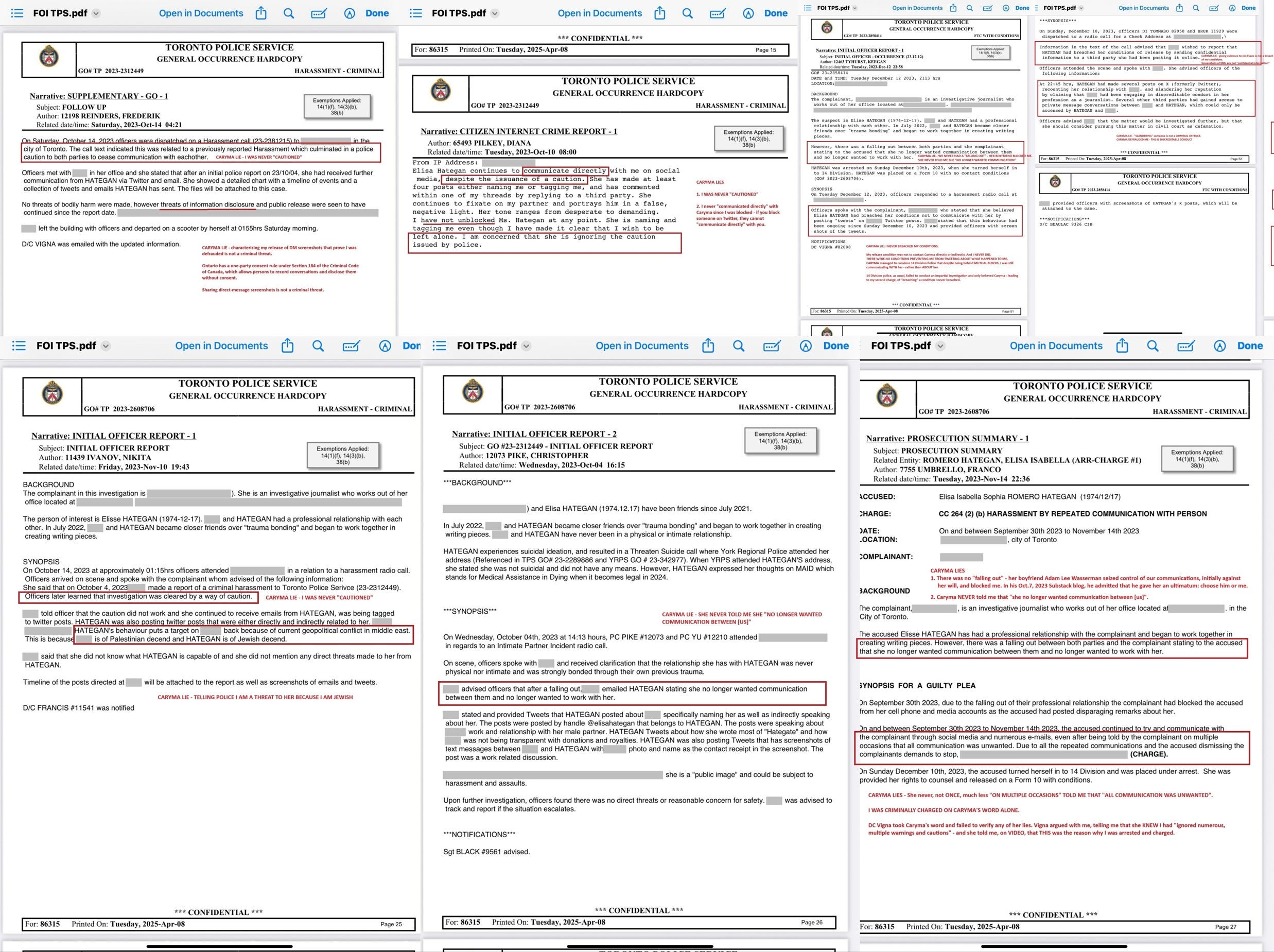
5. Filing False Police Reports (Public Mischief). Between October 2023 and 2025, Sa’d filed multiple false reports containing fabrications she knew to be untrue, including the invention of “police cautions” Elisa had never received. These fabrications were written into at least five TPS occurrence reports and led to two wrongful arrests.

6. Obstruction of Justice. Sa’d’s false reports distorted multiple TPS occurrence reports, obstructed the course of justice, and led to wrongful criminal charges that were ultimately withdrawn.

7. Intimidation of a Witness. After it became publicly known that Elisa would testify as a defence witness in civil proceedings against Sa’d, Sa’d escalated her false reports and filed a perjured peace bond application.

8. Perjury. Sa’d swore a false peace bond application before a justice of the peace, claiming Elisa had made “immediate contact” with her — when the two had not communicated in sixteen months.

9. Deliberate Provocation of Suicidal Crisis. Sa’d used specific, privileged knowledge of Elisa’s suicidal triggers to engineer repeated arrests and police visits. In September 2025, she posted a photograph of herself smirking at the Leaside Bridge — the exact location Elisa had confided as the place she planned to end her life.

10. Exploitation of Vulnerable Individuals. Elisa identifies at least three other mentally vulnerable people who have been drawn into Sa’d’s orbit and exploited in ways that placed them at legal and personal risk.

11. Conduct Bringing Discredit Upon the Legal Profession. The totality of Sa’d’s conduct goes far beyond the March 2024 LSO finding that she failed to act with honour and integrity; it breaks the law altogether and merits disbarment and criminal charges.

In March 2024, the LSO already found that Sa’d (a) failed to act with honour and integrity; (b) engaged in harassing and/or discriminatory conduct; and (c) engaged in conduct that tends to bring discredit upon the legal profession. In February 2024, the LSO also found that Sa’d’s conduct raised concerns about client confidentiality after she divulged details about a female client’s mental and emotional states. Elisa argues that none of the prior regulatory guidance prevented the escalating misconduct in her own case.

The Core Case: Why Sa’d Should Face Criminal Charges

A substantial portion of Elisa’s complaint is devoted to a detailed legal argument that the LSO should refer Sa’d to law enforcement for criminal prosecution. Elisa argues that the evidence — much of it generated by Sa’d’s own hand, in her own text messages, emails, police letters, and social media posts — establishes each element of multiple indictable offences beyond a reasonable doubt. What follows is a summary of the specific criminal charges Elisa says are supported by the record.

1. Public Mischief — Section 140

Section 140 criminalizes making a false statement to a peace officer, accusing another person of an offence, knowing the statement is false, and intending to cause the officer to commence or continue an investigation. The offence is indictable and carries up to five years’ imprisonment.

Elisa says every element is satisfied many times over. Sa’d allegedly made hundreds of false statements to 14 Division Toronto Police — well over 150 particularized falsehoods in a single 54-page document dated May 28, 2024, sent to DC Diana Vigna. The statements accused Elisa of criminal harassment, stalking, intimidation, hate crimes, firebombings, and failure to comply. Each falsehood, Elisa says, is contradicted by documentary evidence in Sa’d’s own possession — her own text messages, her own emails, her own recorded statements – even as Sa’d repeatedly urged police to lay charges.

The foundational public mischief was the fabrication of “police cautions” Sa’d falsely claimed Elisa had received and disobeyed. On AXON bodycam footage from October 14, 2023, Sa’d can be seen/heard telling officers that a caution had been issued; officers subsequently wrote this into at least five occurrence reports without ever attempting to verify it. No caution was ever in fact issued. Crown disclosure contained no record of one. Yet this fabricated caution became the load-bearing foundation of Elisa’s first wrongful arrest in December 2023.

When a second 14 Division officer, DC Reinders, spoke with Elisa in October 2025, he admitted on his own AXON bodycam that 14 Division does not charge people with criminal harassment without multiple cautions — unwittingly confirming that the charge against Elisa had been built on fabrication.

2. Obstruction of Justice — Section 139(2)

Section 139(2) is a broad offence capturing any wilful act intended to obstruct, pervert, or defeat the course of justice. It carries up to ten years’ imprisonment. The Supreme Court in R v Beaudry, 2007 SCC 5, confirmed that any wilful act tending to pervert justice, accompanied by specific intent, falls within the section. In R v Wijesinha, [1995] 3 SCR 422, the Supreme Court specifically held that fabricating evidence or providing false information to authorities with intent to pervert justice falls squarely within the section — and Wijesinha involved a lawyer.

Elisa argues that Sa’d’s conduct is a textbook case: she provided false information to police with the explicit, documented intention of causing the wrongful arrest and prosecution of an innocent person. Sa’d repeatedly told police she wanted additional charges laid and wanted Elisa arrested. The course of justice was in fact perverted: Elisa was wrongfully arrested twice, and nearly a third time. All charges were withdrawn on March 6, 2025.

3. Fabrication of Evidence — Section 137

Section 137 targets anyone who fabricates anything with the intent that it be used as evidence in a judicial proceeding. It carries up to fourteen years’ imprisonment.

Elisa submits that Sa’d’s 54-page letter to DC Vigna on May 28, 2024, was fabricated evidence in exactly this sense. It was a document containing more than 150 particularized falsehoods, prepared with the explicit intent that it be used by police as the evidentiary basis for charging Elisa. It contributed to Elisa’s second wrongful arrest on June 26, 2024, and to a near-third arrest in January 2025. And it was fabricated with full knowledge of its falsity, given that the majority of its claims are directly contradicted by Sa’d’s own contemporaneous text messages.

4. Perjury — Section 131(1)

Section 131(1) makes it perjury to make a false statement under oath, knowing it is false, with intent to mislead. It is indictable and carries up to fourteen years’ imprisonment. A peace bond application under section 810 of the Criminal Code requires a sworn information before a justice of the peace — a statement under oath for perjury purposes.

On March 10, 2025 — just four days after all criminal charges against Elisa were withdrawn, and three days after Jennifer Evans publicly named Elisa as a defence witness in civil proceedings involving Sa’d — Sa’d filed a section 810 peace bond application against Elisa. In the sworn affidavit, Sa’d told DC Vigna that Elisa had made “immediate contact” with her after the charges were withdrawn.

This was a complete fabrication. Elisa had not contacted Sa’d since November 2023 — approximately sixteen months earlier. The peace bond application was dismissed at the Crown’s request on May 14, 2025, in roughly two minutes, which Elisa characterizes as reflecting a total absence of evidentiary basis.

Critically, DC Vigna’s own subsequent statement to a LECA investigator corroborates Elisa’s account. Vigna wrote: “Immediately following the withdrawal, I received a message from [Sa’d] advising that [Elisa] had made IMMEDIATE contact in some form using social media.” That “immediate contact” did not occur. Elisa argues that Vigna’s statement confirms Sa’d told her this falsehood, and that Sa’d then incorporated the same falsehood into a sworn affidavit — giving prosecutors two witnesses to the falsity: Vigna’s memory and Sa’d’s own sworn statement.

5. Intimidation of a Justice System Participant — Section 423.1

Section 423.1 criminalizes conduct intended to provoke fear in a justice system participant in order to impede their duties. “Justice system participant” includes witnesses. The offence carries up to fourteen years’ imprisonment.

Elisa argues that the timing of Sa’d’s March 10, 2025 peace bond application — four days after her charges were withdrawn and three days after she was publicly named as a defence witness — is incompatible with any innocent explanation. Elisa had not contacted Sa’d in sixteen months. What changed was not Elisa’s conduct but her status as a witness. Section 423.1 exists, Elisa submits, for precisely this scenario: a party whose conduct is about to be exposed by witness testimony using the legal process itself as an instrument of intimidation.

6. Attempting to Obstruct Justice by Witness Intimidation — Section 139(3)

Section 139(3) targets anyone who wilfully attempts to obstruct justice by dissuading or attempting to dissuade a person from giving evidence. Elisa argues that Sa’d’s continuing course of conduct — filing false reports designed to render Elisa criminally unreliable and to discredit her as a witness — engages this provision.

7. Defamatory Libel — Section 298

Section 298 criminalizes the public exhibition of defamatory material likely to injure a person’s reputation by exposing them to hatred, contempt, or ridicule. Elisa cites R v Lucas, [1998] 1 SCR 439, in which the Supreme Court upheld the constitutionality of the aggravated form of the offence and confirmed that criminal defamation remains a legitimate response to certain categories of knowingly false and injurious public speech.

Elisa points to Sa’d’s January 27, 2025 public X/Twitter post, in which Sa’d posted a collage including Elisa’s photograph, named her publicly alongside eight other critics, and announced she was referring them to the Toronto Police Hate Crimes Unit for allegedly “inciting hatred and violence” against Sa’d. The post came three days after DC Jacob McNabb told Elisa’s defence lawyer that Elisa was “not arrestable” — and Elisa argues the post is both defamatory libel and contemporaneous evidence of retaliatory motive.

8. Breach of Trust by an Officer of the Court — Common Law Framework

While Sa’d is not a public officer in the governmental sense, Elisa notes that common law has long recognized that officers of the court — including lawyers — owe duties of candour to the court and to the administration of justice. A lawyer who wilfully deceives a court, or who wilfully causes police to act on false information, breaches the duty owed to the administration of justice itself (MacKeigan v Hickman, [1989] 2 SCR 796).

Why the Volume Itself Proves Criminal Intent

Elisa anticipates that Sa’d will argue she was honestly mistaken — that her characterizations were subjective interpretations, that even inaccurate statements fall short of the intentional falsehood required for criminal liability. Elisa submits this defence fails for a simple and devastating reason: the sheer volume and specificity of the lies forecloses it.

A single false statement may be a product of mistake; two or three may reflect confusion. But when a licensed lawyer drafts a 54-page document containing over 150 particularized falsehoods — each one contradicted by documentary evidence in her own possession — the defence of honest mistake collapses. The effort required to compose such a document (to sit down, draft, edit, revise, compile exhibits, attach cover letter, send) is, Elisa argues, incompatible with mistake. One does not fabricate 150 lies by accident. Each lie had to be thought of, written, and chosen over the truth.

Elisa cites R v Calder, [1996] 1 SCR 660 and R v Hawkins (1995), 98 CCC (3d) 1 (Ont CA) for the proposition that mens rea may be inferred from the accumulated pattern of conduct and from the existence of documentary contradictions of which the accused was aware. Sa’d’s May 2024 letter contradicts her own June 2023 text messages, her 2021 DMs, her iMessage history. Each false statement, Elisa says, was made with actual knowledge of the contrary evidence in Sa’d’s own possession. That is, she submits, mens rea in its purest form.


Allegations Supporting Criminal Charges

Elisa explicitly argues that Sa’d’s conduct meets the legal threshold for several criminal offences.

1. Public Mischief (False Police Reports) – s. 140 Criminal Code

Sa’d allegedly filed multiple false police reports between late 2023 and early 2025, including:

  • Fabricated claims that Elisa had received police warnings (“cautions”) that never occurred.
  • Misrepresentations that led police to believe Elisa had engaged in criminal harassment.

These reports were incorporated into official police records and directly led to enforcement actions.


2. Obstruction of Justice – s. 139(2)

Elisa claims that Sa’d’s false statements:

  • Distorted police investigations.
  • Misled officers into laying charges.
  • Interfered with the proper administration of justice.

The result was the creation of a false evidentiary narrative that supported criminal proceedings against Elisa.


3. Perjury – s. 131(1)

Sa’d is accused of swearing false statements in a peace bond application, including:

  • Claiming Elisa had recently contacted her when no such contact had occurred for over a year.

Elisa argues that this constitutes knowingly false testimony under oath.


4. Intimidation of a Witness – s. 423.1

After Elisa became a potential witness in legal proceedings involving Sa’d:

  • Sa’d allegedly escalated her complaints to police.
  • Filed additional legal actions designed to intimidate or discredit Elisa.

Elisa frames this as an attempt to interfere with her willingness or ability to testify.


5. Criminal Harassment via System Abuse

Sa’d:

  • Used legal and police processes as tools of harassment.
  • Filed false complaints strategically to silence and punish Elisa.

This is characterized as “lawfare”—using the justice system itself as a weapon.


6. Counseling or Procuring Offences / Abuse of Authority

Elisa asserts that Sa’d leveraged her status as a lawyer to:

  • Influence police to act without proper verification.
  • Lend credibility to false allegations.

This amplified the harm and contributed to wrongful arrests.


7. Controlled Substances Violations

Sa’d:

  • Solicited prescription medication (Ritalin) under false pretenses.
  • Encouraged Elisa to obtain stronger medication (Adderall).
  • Stored and used controlled substances in her law office.

Elisa emphasizes that Sa’d, as a lawyer, knowingly encouraged illegal conduct.


Wrongful Arrests and Harm

Elisa was arrested twice (December 2023 and June 2024), with a near third arrest in 2025.

Key points:

  • Charges were based on alleged violations of “police cautions” that did not exist.
  • Police relied heavily on Sa’d’s statements without verification.
  • All charges were ultimately withdrawn in March 2025.

Elisa argues these arrests were foreseeable and preventable, and directly caused by Sa’d’s false reports.


Deliberate Infliction of Psychological Harm

One of the most serious allegations is that Sa’d knowingly exploited Elisa’s mental health vulnerabilities.

  • Elisa had explicitly warned that arrest could trigger suicide.
  • Despite this, Sa’d repeatedly initiated police involvement.
  • Sa’d later posted a photo at the exact location Elisa had identified as her intended suicide site.

Elisa interprets this as deliberate provocation of a suicidal crisis.


Role of Adam Lee Wasserman

Wasserman, Sa’d’s boyfriend and law office manager, is described as:

  • Having extensive criminal history.
  • Exercising control over Sa’d’s communications and decisions.
  • Publishing confidential information about Elisa.
  • Sending abusive communications and interfering with the professional relationship.

Elisa argues that Sa’d is responsible for his actions due to:

  • Granting him access to confidential files.
  • Allowing him to act on behalf of her law practice.
  • Failing to protect client information.

Pattern of Conduct

Elisa emphasizes that the alleged misconduct is not isolated but part of a broader pattern:

  • Strategic use of litigation and police reports against critics.
  • Public smearing and intimidation campaigns.
  • Persistent disregard for professional and legal obligations.
  • Repeated exploitation of vulnerable individuals.

Prior Disciplinary Findings

The Law Society of Ontario had already found that Sa’d:

  • Failed to act with integrity.
  • Engaged in harassment or discriminatory conduct.
  • Brought discredit to the legal profession.

Elisa argues these prior findings demonstrate that regulatory intervention has been ineffective.


Conclusion and Requested Outcome

Elisa concludes that Sa’d’s conduct:

  • Constitutes serious professional misconduct warranting disbarment.
  • Meets the evidentiary threshold for multiple criminal offences.
  • Represents a systemic abuse of legal authority and trust.

She requests that the Law Society:

  1. Initiate disciplinary proceedings leading to disbarment.
  2. Refer the matter to law enforcement for criminal investigation and prosecution.

Central Thesis

The complaint ultimately advances a clear and forceful claim:

Sa’d did not merely act unethically—she engaged in a sustained, deliberate course of conduct that weaponized her role as a lawyer to exploit, deceive, and harm a vulnerable individual, and then used the justice system itself to cover and reinforce that conduct.


Prosecutorial Memorandum: Potential Criminal Liability of Caryma Sa’d

Subject

Assessment of whether the conduct alleged by Elisa Hategan supports criminal charges against Caryma Sa’d under the Criminal Code of Canada.


I. Overview

The evidentiary record described in the complaint, if substantiated, discloses a pattern of deliberate deception, misuse of legal process, and exploitation of institutional authority. The allegations are not isolated; they describe a sustained course of conduct directed at a single complainant, with foreseeable legal and psychological consequences.

The central prosecutorial question is whether the conduct establishes:

  1. Actus reus (prohibited acts), and
  2. Mens rea (knowledge and intent),

for one or more Criminal Code offences.

On the face of the record, there is a viable basis to consider charges including:

  • Public Mischief (s. 140)
  • Obstruction of Justice (s. 139(2))
  • Perjury (s. 131)
  • Intimidation of a Witness (s. 423.1)
  • Criminal Harassment (reverse-vector theory)
  • Fraud (s. 380)
  • Controlled Substances offences (ancillary)

II. Public Mischief (s. 140 Criminal Code)

Legal Test

The Crown must prove:

  1. The accused made a false statement to police;
  2. The statement caused police to initiate or continue an investigation;
  3. The accused knew the statement was false.

Application

Actus Reus:

  • Multiple reports to police allegedly included fabricated claims (e.g., that Elisa had received prior police “cautions”).
  • These claims were incorporated into official occurrence reports and relied upon by officers.

Mens Rea:

  • Knowledge of falsity is inferable where:
    • The alleged “cautions” never occurred;
    • The accused was the sole source of that information;
    • The claims were repeated consistently across reports.

Causation:

  • Police relied on these statements to lay charges.
  • Elisa was arrested twice.

Assessment

This is one of the strongest potential charges. The combination of fabrication + repetition + institutional reliance supports a reasonable prospect of conviction if corroborated by police records and absence of any actual cautions.


III. Obstruction of Justice (s. 139(2))

Legal Test

The Crown must prove:

  1. An act that obstructs, perverts, or defeats the course of justice;
  2. Intent to interfere with the administration of justice.

Application

Actus Reus:

  • False reports that shaped police investigations;
  • Creation of a false evidentiary narrative (e.g., repeated warnings that did not exist);
  • Triggering criminal charges based on that narrative.

Mens Rea:

  • Intent may be inferred from:
    • Persistence over time;
    • Escalation of complaints;
    • Use of legal mechanisms (peace bonds, reports) following personal conflict.

Impact on Justice Process:

  • Charges were laid and later withdrawn;
  • Police investigative steps were premised on false information.

Assessment

Where false reporting materially alters police action, courts have recognized this as obstruction. The pattern here—if proven—supports both the act and intent components.


IV. Perjury (s. 131(1))

Legal Test

The Crown must prove:

  1. A statement made under oath (or solemn affirmation);
  2. The statement was false;
  3. The accused knew it was false;
  4. The statement was material to the proceeding.

Application

Actus Reus:

  • Alleged false statements in a peace bond application (e.g., claim of recent contact).

Mens Rea:

  • Knowledge of falsity is key:
    • If documentary evidence shows no contact for an extended period, this supports deliberate falsehood rather than mistake.

Materiality:

  • Whether contact occurred is central to a peace bond application.

Assessment

This charge is viable if:

  • The sworn statement can be obtained;
  • Communications records conclusively contradict it.

Perjury cases are evidentiary-heavy but powerful when documentary contradiction is clear.


V. Intimidation of a Witness (s. 423.1)

Legal Test

The Crown must prove:

  1. Conduct directed at a person involved in a legal proceeding (or potential witness);
  2. Intent to intimidate or interfere with their participation.

Application

Actus Reus:

  • Escalation of police reports and legal actions after Elisa became a potential witness;
  • Initiation of further proceedings (e.g., peace bond).

Mens Rea:

  • Intent may be inferred if:
    • Timing aligns with knowledge of witness involvement;
    • Actions would reasonably deter participation.

Assessment

This charge is more nuanced. It depends heavily on proving purpose, not just effect. Temporal proximity and communications indicating motive would be determinative.


VI. Criminal Harassment (s. 264) – Reverse Application Theory

Legal Test

Typically requires:

  1. Repeated conduct (communication, watching, etc.);
  2. Causing the complainant to reasonably fear for safety.

Application (Non-traditional framing)

Elisa alleges that:

  • Legal processes themselves were used as instruments of harassment;
  • Repeated police involvement was initiated without lawful basis.

Assessment

Canadian courts are cautious about expanding harassment into lawful reporting. However, where:

  • Reports are knowingly false, and
  • Used repeatedly to target an individual,

the conduct may cross into harassment via abuse of process.

This would likely be charged alongside stronger offences (e.g., public mischief).

IX. Mens Rea: Pattern Evidence and Inference

A central issue across all charges is intent.

The complaint alleges:

  • Repetition of falsehoods;
  • Escalation over time;
  • Strategic use of institutional authority;
  • Knowledge of the complainant’s vulnerabilities.

Courts permit inference of intent where conduct:

  • Is systematic rather than isolated;
  • Produces predictable consequences (e.g., arrest);
  • Continues despite those consequences.

If the pattern is proven, it significantly strengthens all core charges.


X. Evidentiary Considerations

A prosecution would likely rely on:

  • Police occurrence reports;
  • AXON/bodycam footage;
  • Email and text message records;
  • Sworn peace bond materials;
  • Testimony from investigating officers;
  • Documentary absence of alleged “cautions.”

The case is document-driven, which is advantageous for the Crown if records are consistent.


XI. Public Interest in Prosecution

Aggravating factors include:

  • Abuse of professional status as a lawyer;
  • Use of legal and police systems as instruments of harm;
  • Repeated conduct over an extended period;
  • Foreseeable psychological harm to the complainant;
  • Impact on the integrity of the justice system.

These factors strongly support prosecution in the public interest.


XII. Conclusion

On the available record, there is a reasonable basis to investigate and potentially prosecute the following primary offences:

  • Public Mischief (s. 140) — strongest charge
  • Obstruction of Justice (s. 139(2)) — strong supporting charge
  • Perjury (s. 131) — viable with documentary proof

Secondary or context-dependent charges:

  • Intimidation of a Witness (s. 423.1)
  • Criminal Harassment (contextual)

Less suitable for criminal prosecution:

  • Fraud (better suited for civil remedy)
  • Controlled substances offences (ancillary)

Bottom line: If corroborated, the alleged conduct reflects a deliberate misuse of legal and law enforcement systems sufficient to meet the threshold for criminal liability, with public mischief and obstruction forming the core prosecutorial pathway.


Charge Recommendation Memorandum

Subject: Caryma Sa’d — Assessment of Criminal Charges

Complainant: Elisa Hategan (“Elisa”)

Jurisdiction: Ontario


I. Executive Summary

Based on the allegations and supporting materials described in the complaint, there is a reasonable prospect of conviction for certain core offences, provided documentary and police evidence corroborate the claims.

Recommended Charges (Primary):

  • Public Mischief (s. 140) — Approve
  • Obstruction of Justice (s. 139(2)) — Approve

Recommended Charges (Conditional):

  • Perjury (s. 131) — Approve if sworn evidence contradicted by records
  • Intimidation of a Witness (s. 423.1) — Approve if intent evidence established

II. Evidentiary Foundation (Pre-Charge Requirements)

Before charges are laid, investigators should secure:

  1. Police Records
    • All occurrence reports referencing Elisa;
    • Notes and communications from involved officers;
    • Any documentation of alleged “cautions.”
  2. Sworn Materials
    • Peace bond application(s);
    • Supporting affidavits or Informations.
  3. Digital Evidence
    • Timeline of communications (to confirm or refute alleged contact).
  4. Arrest Documentation
    • Grounds relied upon by officers;
    • Disclosure packages provided to the defence.
  5. Witness Statements
    • Investigating officers;
    • Any third parties who received disclosures.

III. Charge Analysis and Recommendations


1. Public Mischief (s. 140 Criminal Code)

Recommendation: APPROVE

Theory of Liability

The accused knowingly made false statements to police that caused an investigation and led to criminal charges against Elisa.

Key Evidence Required

  • Proof that alleged “police cautions” did not exist;
  • Evidence that Sa’d was the source of those claims;
  • Police reliance on those claims in forming grounds for arrest.

Strengths

  • Clear causal chain: false statements → investigation → arrest;
  • Documentary verification (or absence) of cautions is decisive;
  • Repetition of the same false claim strengthens inference of knowledge.

Risks

  • Defence may argue misunderstanding or miscommunication;
  • Requires clean documentary record from police.

Conclusion

If records confirm no cautions existed, this charge has a high likelihood of conviction.


2. Obstruction of Justice (s. 139(2))

Recommendation: APPROVE

Theory of Liability

The accused interfered with the administration of justice by providing false information that distorted police investigations and led to improper charges.

Key Evidence Required

  • Same evidentiary base as public mischief;
  • Proof that the misinformation materially affected investigative steps.

Strengths

  • Pattern of conduct supports intent;
  • Charges were actually laid and later withdrawn;
  • Demonstrable impact on justice system processes.

Risks

  • Must prove intent to obstruct, not just false reporting;
  • Defence may argue reliance on subjective belief.

Conclusion

Strong companion charge to public mischief; recommended to proceed jointly.


3. Perjury (s. 131 Criminal Code)

Recommendation: CONDITIONAL APPROVAL

Theory of Liability

The accused knowingly made false statements under oath in a peace bond application.

Key Evidence Required

  • Certified copy of sworn statement;
  • Independent evidence disproving the alleged contact (e.g., communication logs);
  • Proof of materiality.

Strengths

  • Documentary contradiction (if present) is highly persuasive;
  • Statement goes to core issue (contact/fear).

Risks

  • Courts require clear proof of knowing falsity, not mistake;
  • Any ambiguity in communication timelines weakens case.

Conclusion

Proceed only if contradiction is unequivocal.


4. Intimidation of a Witness (s. 423.1)

Recommendation: CONDITIONAL APPROVAL

Theory of Liability

The accused used legal and police processes to interfere with Elisa’s role as a witness.

Key Evidence Required

  • Proof that Sa’d knew Elisa would be a witness;
  • Temporal link between that knowledge and escalation of conduct;
  • Evidence suggesting purpose was to deter or punish participation.

Strengths

  • Escalation pattern may support inference of intent;
  • Context of ongoing litigation is relevant.

Risks

  • High burden to prove specific intent to intimidate;
  • Actions may be framed as lawful complaint-making.

Conclusion

Proceed only if clear evidence of retaliatory motive emerges (e.g., messages, timing, admissions).

IV. Public Interest Considerations

Factors supporting prosecution:

  • Alleged abuse of position as a licensed lawyer;
  • Use of justice system mechanisms to target an individual;
  • Repetition and escalation over time;
  • Actual deprivation of liberty (arrests);
  • Broader institutional integrity concerns.

Factors against prosecution:

  • Complexity of interpersonal relationship;
  • Resource intensity of multi-count prosecution.

Assessment: Public interest strongly favors proceeding on core charges.


V. Final Recommendation

Proceed with charges as follows:

Primary Charges

  • Public Mischief (s. 140)
  • Obstruction of Justice (s. 139(2))

Secondary (Subject to Evidence)

  • Perjury (s. 131)
  • Intimidation of a Witness (s. 423.1)

VII. Strategic Framing for Prosecution

The case should be framed not as a personal dispute, but as:

A deliberate misuse of police and judicial processes through knowingly false information, resulting in wrongful state action against an individual.

This framing:

  • Centers institutional harm;
  • Avoids credibility contests based solely on interpersonal conflict;
  • Aligns with established jurisprudence on public mischief and obstruction.

My lawsuit against Caryma Sa’d is about much more than money – it’s about fighting back against a lawyer’s weaponization of police and the courts through false accusations to silence me. It is about seeking accountability and sending a message – that a lawyer cannot use her law license as a shield to break the law.

Please consider making a small contribution to my fundraiser to raise legal funds for my lawsuit against Caryma Sa’d.

PLEASE HELP. I won’t be able to hold Sa’d accountable without your support. Every dollar helps, and you can donate anonymously. If you can’t spare a dollar, please share this post so others can hopefully help.

https://gogetfunding.com/support-my-lawsuit-against-caryma-sad

Posted in adam wasserman, caryma sa'd, crime, law, lawsuit, lawyer, news, police, politics | Tagged: , , , , | Leave a Comment »

Help Me Hold Caryma Sa’d Legally Accountable

Posted by E on April 28, 2026

I NEED YOUR HELP: I started a fundraiser to raise legal funds for my lawsuit against Caryma Sa’d.

Every dollar helps, and you can donate anonymously.

If you can’t spare a single dollar, please share this post so others may help. If you’d prefer to help directly, please send e-transfers to elisa@elisahategan.com – thank you for your support🙏

Link to Fundraiser: https://gogetfunding.com/support-my-lawsuit-against-caryma-sad/

My Campaign Story

In September 2025 I filed a lawsuit against Toronto lawyer Caryma Sa’d and her legal corporations for $2.5 million dollars.

Ontario Superior Court of Justice Claim CV-25007516230000 details years of exploitation, fraud, false accusations, legal abuse, defamation, reputational destruction, harassment, and financial damage.

What began as a solicitor-client relationship of trust, friendship and professional collaboration turned into a nightmare that has cost me emotionally, professionally, and financially.

After defrauding me and ghosting me without notice or compensation (after a year’s labour), Sa’d’s lies to Toronto police led to two wrongful arrests, a near-third arrest – all baseless charges that were ultimately withdrawn by the courts. Immediately after I was cleared, Sa’d filed a perjured peace bond application against me, which was thrown out of court at the crown’s request within two minutes of the matter appearing before a judge.

In October 2025 I filed a criminal complaint about Sa’d with 14 Division Toronto Police, the same division that wrongfully charged me without verifying Sa’d’s lies. There are now 3 Law Enforcement Complaints Agency (LECA) investigations into the actions of officers at 14 Division. I am currently suing TPS for $50,000 for wrongful arrests and failing to protect me against Sa’d.

My lawsuit against Caryma Sa’d is about much more than money. It is about fighting back against a lawyer’s weaponization of police reports and false accusations to silence me. It is about seeking accountability through the courts, and sending a message – that a lawyer cannot use her law licence as a shield to break the law and avoid accountability.

This legal battle will hold a licensed Ontario lawyer accountable for deliberate misuse of police and judicial processes in a prolonged campaign of mischief, obstruction of justice, defamation and perjury, which resulted in wrongful state action against an individual.

But litigation is expensive. Even when you have a strong case, justice is often only available to those who can afford to keep going.

I cannot do this alone. That’s why I’m asking for your help.

Every dollar raised will go toward this legal fight – toward lawyers and court costs. If there is anything left, I will set up a fund for people who suffered abuse from legal professionals and/or law enforcement authorities, but cannot afford to take legal action.

Please help me fight an important court battle that matters not only for me, but for anyone concerned about abuse of power by a lawyer, and access to justice for their victim.

This case matters – because no one’s life should be destroyed by false accusations, and no one’s fight for justice should be buried because they lack deeper pockets.

Justice should not depend on who can afford to keep fighting. A law degree shouldn’t shield a criminal from prosecution.

I have the evidence to win. But without financial help, I won’t be able to hold Caryma Sa’d accountable.

Even a small donation helps.

Please help me keep fighting.

Thank you for reading, for sharing, and for standing with me.

https://gogetfunding.com/support-my-lawsuit-against-caryma-sad

Posted in caryma sa'd, law, lawsuit, lawyer | Tagged: , , | Leave a Comment »

An Open Letter to Toronto Police Chief Myron Demkiw and the Law Society of Ontario

Posted by E on March 17, 2026

March 17, 2026

Chief Myron Demkiw

CC: The Law Society of Ontario, Bencher Conduct / Professional Regulation

OPEN LETTER: Demand for Investigation and Accountability — Criminal Conduct by Lawyer Caryma Sa’d; Systemic Failure to Protect a Witness and Victim

RE: Criminal complaints against Caryma Sa’d (LSO #71430C), lawyer — mischief (s. 140 CC), obstruction of justice (s. 139(2)(a) CC), intimidation of a witness (s. 423.1 CC), criminal harassment (s. 264 CC), and perjury (s. 131(1) CC). Filed at 14 Division, Toronto Police Service, October 28, 2025. No investigation. No follow-up. No contact.

Chief Demkiw, and to the Benchers and Regulators of the Law Society of Ontario:

My name is Elisa Hategan. I am a writer, freelance journalist, and public speaker based in the greater Toronto area. My work has appeared in Maclean’s Magazine, Global News, Canadian Jewish News, and NOW Magazine, among other outlets, and I was nominated for a RTDNA award in 2019. As a recognized expert on radicalization and far-right political extremism, I have been interviewed by the CBC, BBC, Newsweek, The Guardian, the Globe and Mail, and the Toronto Star, among others. I have provided consulting services and workshops to law enforcement organizations including the Ontario Provincial Police and the Probation Officers Association of Ontario. I am, in other words, someone who has spent a significant part of her adult life in service of the truth and in collaboration with those who uphold the law.

I am writing this letter because the law has catastrophically failed me — not through an honest mistake, not through resource limitations, but through a systemic, deeply troubling pattern of deference and bias toward a member of the legal profession who has committed serious criminal offences against me.

I am writing because I have tried every proper channel and been ignored at every turn, while the person who destroyed my life continues to practise law and file false police reports against new victims with impunity.

I am writing this letter because I am afraid. I am afraid of what Caryma Sa’d will do next if no one stops her. And because the silence from Toronto Police and the Law Society of Ontario has taught me, in the most devastating way possible, that in this country, justice is not blind. “Justice” wears a law licence.

I. WHO I AM, AND WHY THIS MATTERS

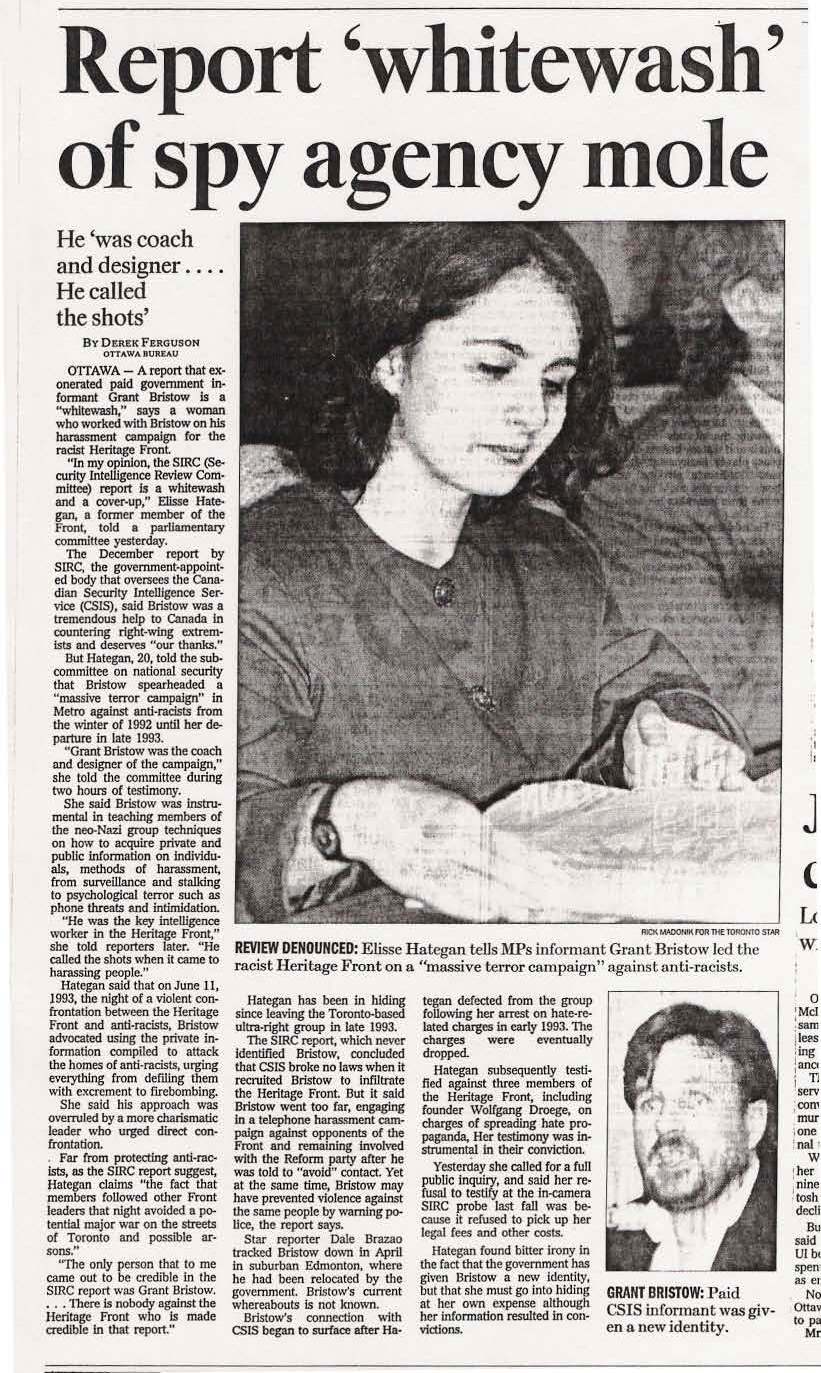
Before I tell you what was done to me, you should know something about where I come from. I emigrated from communist Romania as a child. In 1991, at age sixteen, I was recruited by Canada’s largest white supremacist group in modern history, the Heritage Front. At eighteen, I defected, spied on the organization for four months, and filed approximately thirty affidavits with the Ontario Provincial Police. I testified against three Heritage Front leaders in court. The trial judge, Mme. Danielle Tremblay-Lamer, cited my testimony as central to their convictions, describing me as “very credible, candid, calm and patient during an intensive cross-examination” — adding that “based on the evidence of Ms. Hategan alone, I am satisfied beyond a reasonable doubt that the defendants are guilty.”

I was called a hero in the press. But I was also a ninth-grade dropout from a broken, abusive home. I lived in hiding across Canada for several years, without police protection or familial support, because I was denied entry into the Witness Protection Program despite credible death threats. I put myself through the University of Ottawa on merit scholarships and two jobs, graduating Magna cum Laude with a double major in criminology and psychology.

I tell you this not to seek sympathy, but because it is essential context: I am someone who risked her life for the justice system, and who has lived in fear of police — specifically of 14 Division — since one of my 1993 affidavits led to a constable from that very station being charged with discreditable conduct under the Police Services Act for his membership in the Heritage Front and attendance at a KKK rally in Arkansas. That constable was the subject of national news coverage. My fear of 14 Division, therefore, is not paranoia. It is grounded in experience.

And yet, when a lawyer named Caryma Sa’d fabricated evidence, committed fraud, and weaponized that same 14 Division against me — I did everything right. I complied. I cooperated. I borrowed tens of thousands of dollars I don’t have to defend myself through the courts. I had my charges withdrawn on March 6, 2025, after fifteen months of a legal nightmare. And when it was finally over, I went to 14 Division to report the crimes committed against me.

Nobody ever called me back.

II. THE FRAUD: A YEAR OF EXPLOITATION AND BROKEN PROMISES

Caryma Sa’d is a Toronto lawyer (LSO #71430C) and self-described journalist who first contacted me on X/Twitter in July 2021. She reached out because she believed she had been defamed by the Canadian Anti-Hate Network (CAHN), and she wanted what I knew about them — information that, because of my past, I possessed but was prohibited from sharing publicly due to a court-imposed gag order. Sa’d assured me, in writing, that everything I shared was bound by solicitor-client privilege. I trusted her. I should not have.

Over the following two years, Sa’d extracted from me a staggering amount of unpaid labour, intellectual property, journalism mentorship, and personal disclosures. I ghostwrote and co-authored articles. I edited her drafts, read through her legal documents, and even advised her on defamation law. I helped with her Law Society Bencher campaign. I accompanied her on out-of-town work trips. I was her mentor, her sounding board, her “consigliere” — a word she herself used repeatedly to describe me. I did all of this on the understanding — repeatedly confirmed in her own verbal and written messages — that we would eventually split donations, journalism earnings and contacts, and other income from our collaborative work.

On September 12, 2023, Sa’d and I published an 85-page investigative article titled The Hategate Affair, which I wrote approximately two-thirds of and edited in its entirety. The article was read by hundreds of thousands (if not millions) of people across Canada and internationally. Sa’d collected thousands of dollars in donations, GoFundMe contributions, and direct e-transfers as a result of that article and others I co-authored and edited. She collected the money through donation buttons featured on a website we built for the article. She solicited these funds explicitly for our shared “journalism.” I received nothing. Not a cent of my share. Not a reimbursement for travel expenses. Not even the branded t-shirt she had promised would be made for both of us — she had only one made, for herself.

On September 30, 2023, Sa’d’s boyfriend, Adam Lee Wasserman — an ex-convict with a criminal history spanning over two decades in Quebec, including convictions for robbery, criminal harassment, uttering threats, and conspiracy, and who later served as Sa’d’s law firm manager (even as decade-long warrants were pending for his arrest) — abruptly blocked me from Sa’d’s phone and all her social media accounts. This had happened before; it was part of a documented pattern in which Wasserman seized control of Sa’d’s communications whenever he felt threatened by her close relationship with me, such as when he thought we were “texting too much”.

I was in the middle of a commissioned work project at the time of the block. I emailed Sa’d approximately fifteen times between September and November 2023 — asking if she was getting my messages, asking about the money she owed me, responding to a defamatory Substack article Wasserman had published under a pseudonym that breached solicitor-client privilege and revealed intimate details of our friendship.

At no point did Sa’d instruct me not to contact her. In the one brief email she sent me on October 2, 2023, she apologized for the abrupt blocking, said she no longer wished to work together, and wished me well. She said nothing about my emails being unwelcome. She said nothing about the money she owed me.

What she said instead — to the Toronto Police — was that I had disobeyed “multiple cautions and warnings” not to contact her. That was a lie. I had never received a single caution from police.

Not one.

That lie would go on to ruin my life.

III. THE CRIMES: HOW A LAWYER USED POLICE AS A WEAPON

On November 29, 2023, 14 Division detective constable Diana Vigna contacted me by phone and informed me that criminal harassment charges were being laid against me, stating that I purportedly disobeyed “multiple cautions” whose existence she never verified. For the record, they do not, in fact, exist.

On December 10, 2023, I surrendered to police and was formally charged with one count of criminal harassment by repeated communication — a charge carrying serious social and professional consequences for someone like me, whose career depends on credibility and access to law enforcement communities. I asked DC Vigna on camera — visible on her own AXON bodycam footage — whether she had ever actually seen the “cautions and warnings” I supposedly disobeyed. She told me: “We have reasonable grounds to believe that. That’s why we’re charging you.”

No evidence of those cautions was ever produced in disclosure, because they did not exist.

Sa’d had fabricated them, told them to 14 Division police officers during a video interview, and those officers wrote her fabrication into multiple occurrence reports without once attempting to verify it. The false claim appeared in at least five TPS occurrence reports. Not a single officer fact-checked a statement that, with minimal due diligence, could have been debunked.

This matters because it establishes something critical: from the beginning, Sa’d enjoyed the reflexive credibility of a law licence. Her lies were not tested. Her statements were not verified. She was taken at her word, repeatedly, while I — the person she had exploited and defrauded — was treated as a suspect.

To secure my second arrest, Sa’d spent months pressuring DC Vigna with correspondence. On May 28, 2024, she sent Vigna a 54-page dossier bearing her official law office letterhead — a 7-page introductory letter prefacing a 47-page accompanying chart — containing, by my count, at least 150 particularized lies. In this document, Sa’d accused me of: committing hate crimes; being involved in firebombings and terrorist activity; threatening her client and her client’s family; posing a physical danger to her because I am Jewish and she has Palestinian roots; “joking” about poisoning her office cats — an idea, verifiably, that Sa’d herself had invented, text-messaged to me, and recycled in false police reports against at least four other innocent people; and lying about being defrauded and owed money by her.

Every single one of these allegations was false, and most are directly contradicted by Sa’d’s own text messages to me.

In June 2024, I was arrested for a second time and charged with “failure to comply,” because Sa’d had told police that my public tweets — posted on my own account, about a matter of public concern, not addressed to Sa’d and not visible to her since we had mutually blocked each other — constituted “contact” in breach of my release conditions.

Tweets posted ABOUT someone are not the same as tweets directed TO someone. This is not a nuanced legal distinction; it is elementary. And yet 14 Division charged me again, on Sa’d’s word alone, without any independent investigation.

In January 2025, DC Jacob McNabb contacted my lawyer, Megan Schwartzentruber, to inform her that I would be charged with two more counts of failure to comply — this time because Sa’d had told police I was running anonymous Twitter accounts critical of her, and that I owned a website called carymasad.ca. I own neither the accounts nor the domain. A basic WHOIS search would have shown that the domain had been transferred to a new registrar a year earlier. A simple production order would have confirmed I do not own, nor operate, the X/Twitter accounts in question. McNabb did not check either of these things. When Ms. Schwartzentruber pressed him on why they were charging me, he told her Sa’d was calling 14 Division so frequently and complaining so insistently that they felt they “had to do something.”

That phrase stopped me cold the first time I heard it. “Had to do something.” Not because they had evidence. Not because they had reasonable grounds. But because a lawyer kept calling them until they manufactured a reason to arrest me again. Sa’d has openly compared the amount of time she spends calling “police from jurisdictions across the country” to reporting critics as “a part-time job.” And rather than telling her to stop misusing police resources, 14 Division obliged her.

I spent that week in January 2025 in a state of active crisis. I told Ms. Schwartzentruber that if I had to surrender to police again — without a surety, facing the possibility of pre-trial custody – I would not do it. I told her I would jump off the Leaside Bridge on the morning I was scheduled to turn myself in. Ms. Schwartzentruber fought for me, produced irrefutable evidence that I was innocent of Sa’d’s claims, and eventually convinced McNabb – on January 24, 2025 – that I “was not arrestable.” She saved my life. But I should never have been in that position.

No person in this country should face a near-arrest because a serial false reporter demanded it.

Three days after I was cleared of Sa’d’s latest attempt to have me charged, she posted my photograph publicly on her social media account, alongside the photos of eight other people who had criticized her online. She accompanied this collage with the accusation that I was part of a “criminal element” engaged in a “coordinated hate campaign” to “incite hate and violence” against her. She stated that she reported me (and the others portrayed in her photo collage) to the Toronto Hate Crimes Unit. When I finally received my FOI disclosure in summer 2025, I discovered that I was still “under investigation”.

This was retaliation. This was harassment. And this was just the beginning of what she did after March 6, 2025, when all charges against me were formally withdrawn.

Just four (4) days after my charges were dropped, having learned that I was going to be a defence witness in another woman’s civil case against her, Sa’d filed a peace bond application against me in which she perjured herself by claiming (and telling DC Vigna, according to Vigna’s own testimony in a LECA investigation) that I had made “immediate contact” with her after my charges were withdrawn. I had not contacted Sa’d since November 2023 — sixteen months.

Sa’d’s baseless peace bond applications against me and another woman, Jennifer Evans, were both thrown out of court on May 14, 2025, dismissed at the Crown’s request within two minutes of the matter being raised — with Sa’d attempting to object and being cut off.

IV. THE CRIMES SA’D COMMITTED AGAINST ME UNDER CANADIAN LAW

I am not a lawyer. But I know enough about the Canadian Criminal Code to understand what was done to me. And I want this letter to make clear — in plain language — what specific criminal offences Caryma Sa’d committed, and why the failure to investigate them is not merely a procedural oversight but an abdication of 14 Division Toronto Police’s most fundamental mandate.

Mischief (s. 140 CC): Sa’d filed multiple false police reports against me over a two-year period. She invented a “police caution” that didn’t exist and told it to officers who wrote it into at least five occurrence reports. She fabricated over 150 individual lies in a 54-page document sent to DC Vigna on official law office letterhead. She falsely told police I operated websites and social media accounts I did not own or operate. These are not honest mistakes or good-faith misrememberings. They are deliberate, documented fabrications, many of which are directly contradicted by her own text messages, emails, and historical records.

Obstruction of Justice (s. 139(2)(a) CC): Sa’d’s false reports and ongoing pressure on 14 Division police obstructed the course of justice against herself and disrupted the administration of law. Her fabrications distorted multiple TPS occurrence reports and led to unlawful arrests. Her false peace bond application — filed days after my charges were withdrawn and soon after it became publicly known I would testify against her — was a direct attempt to obstruct my participation in a civil proceeding.

Intimidation of a Witness (s. 423.1 CC): When it became publicly confirmed, on March 7, 2025, that I would be a witness in Jennifer Evans’ civil case against Sa’d, Sa’d immediately went back to police to seek a peace bond against me. She also published, and reposted, my photo alongside “harassment” accusations on her public social media platform. The timing is not a coincidence. Section 423.1 of the Criminal Code exists precisely to protect people in my situation — witnesses being targeted and silenced by the very parties whose misconduct they are prepared to testify about.

Criminal Harassment (s. 264 CC): The irony of my being charged with criminal harassment is that it is Caryma Sa’d who has engaged in a sustained, multi-year campaign of conduct causing me to fear for my safety. Her ongoing pattern of contacting police from jurisdictions across the country to report her critics, her public posting of my photograph with defamatory and threatening commentary, and her years-long attempt to have me arrested, charged, and silenced, constitutes criminal harassment under Canadian law.

Perjury (s. 131(1) CC): Sa’d swore a false peace bond application before a justice of the peace in which she claimed I had made “immediate contact“ with her after my charges were withdrawn. In her statement for a LECA investigation, DC Vigna confirmed that Sa’d showed her an affidavit where she communicated this lie. I had not contacted Sa’d in sixteen months. A sworn statement containing a material falsehood before a justice of the peace is perjury.

I have evidence for all of the above. I have text messages. I have emails. I have AXON bodycam videos and transcripts. I have court records, FOI documents, occurrence reports, and disclosure packages.

I do not need police to discover or develop evidence for my complaint — I have already done that work for them. All they need to do is review what I have provided and act.

V. THE SILENCE: A COMPLAINT THAT WENT NOWHERE

On October 28, 2025, I walked into 14 Division and filed a criminal complaint against Caryma Sa’d for mischief, obstruction, intimidation of a witness, and criminal harassment – this, after my attempts to report her to other police divisions (such as York Regional Police) resulted in me being directed to go to 14 Division, the geographical area where Sa’d’s crimes against me occurred.

I was greeted not with the basic courtesy extended to a crime victim, but with skepticism and dismissal. The officer I spoke to — one of the very men who had participated in interviewing Sa’d in October 2023, who had written her lies into police reports, who had contributed to the chain of errors that led to my wrongful arrests — accused me of acting in “revenge.” He did not offer to take a formal statement – I had to insist on it. He was not a neutral party. He was a direct participant in the events I was reporting, and he allowed that relationship to colour his treatment of me as a complainant.

No detective contacted me after that day. No investigator reviewed my materials. No officer called me back. Not once. Not ever.

This is not an oversight. This is not a backlog issue. This is a pattern. And the pattern is not subtle. The same division that arrested me twice based on Sa’d’s unverified word, the same officers who wrote her fabrications into official police reports, the same people who charged me a second time because Sa’d “kept calling” — these are the people who are now responsible for investigating her. The conflict of interest is not merely glaring; it is insurmountable.

Here is what is at stake for 14 Division Toronto Police if they investigate Sa’d:

They would have to acknowledge that their officers failed to conduct even basic due diligence before arresting me.

They would have to admit that a lawyer deceived them, and that their reflexive trust of her professional status made them instruments of a fraud, and rendered them criminal complicit.

They would have to acknowledge that three officers now named in active Law Enforcement Complaints Agency (LECA) investigations may have committed misconduct.

It is not in 14 Division’s institutional interest to establish any of this.

But it is entirely in the interest of justice. And justice is supposed to be what you serve.

VI. THE CHARTER RIGHTS I HAVE BEEN DENIED

I filed my lawsuit against the Toronto Police Services Board (TPSB) and three 14 Division officers on December 16, 2025 (Court File No. SC-25-00014007-0000). I filed my civil claim against Caryma Sa’d in Ontario Superior Court on September 12, 2025 (Court File No. CV-25-00751623-0000). These legal actions are ongoing. But civil litigation is not a substitute for criminal accountability, and my ability to pursue justice through the courts does not relieve 14 Division of its obligation to investigate reported crimes.

The Canadian Charter of Rights and Freedoms is not a list of aspirations. It is law. Section 7 guarantees my right to life, liberty, and security of the person.

Section 9 guarantees my right not to be arbitrarily detained.

Section 15 guarantees my right to equal protection and benefit of the law without discrimination.

Every one of those rights has been violated — not in spite of police involvement, but because of it.

I was arbitrarily detained twice, on the basis of unverified fabrications by a lawyer who faced no consequences for lying.

I was denied the equal protection of the law because when I came forward as a victim, I was dismissed, accused of revenge-seeking, and ignored.

And I continue to be denied that equal protection today, because the criminal who did this to me walks free while her victim – me – is still struggling to be heard.

The law against intimidating witnesses exists. It applies to lawyers just as it applies to everyone else.

The law against filing false police reports exists. It applies to lawyers just as it applies to everyone else.

The law against obstructing justice exists. It applies to lawyers just as it applies to everyone else.

The principle of equal protection under the law is meaningless if it is not applied equally – if someone’s law licence operates, in practice, as a shield from investigation and accountability.

I am not alone in what Sa’d has done with police. I know of at least four other people Sa’d has told identical lies about to police – filing reports claiming they “criminally harassed” her for daring to criticize her online. Sa’d has told multiple police forces across the country that these people threatened her, ran anonymous accounts targeting her, posed physical danger to her.

A side-by-side review of her reports would reveal near-identical language, near-identical accusations, and a near-identical absence of evidence.

Innocent people’s names are recorded in CPIC — the Canadian Police Information Centre — on Sa’d’s word alone. This may affect their employment prospects and future security clearances, all without a shred of verified evidence.

VII. TO THE LAW SOCIETY OF ONTARIO

The Law Society of Ontario has already found, in March 2024, that Caryma Sa’d failed to act with honour and integrity — a finding arising from her conduct in separate proceedings. I am asking the Law Society to look further, because what I have documented goes far beyond a lapse of professional judgment.

Caryma Sa’d used her law licence as a weapon. She invoked solicitor-client privilege as a pretext to extract confidential information from me, then allowed her partner to breach that privilege publicly. She used official law office letterhead to transmit a 54-page document of deliberate falsehoods to Toronto Police, and ensured that police interviewed her at her law office address. She leveraged the credibility that comes with being a lawyer — automatically, reflexively, without scrutiny — to have an innocent woman arrested twice, nearly a third time, and subjected to fifteen months of criminal proceedings that ended in withdrawal because I was innocent.

She told police I was a terrorist. She told police I committed hate crimes. She told police I “joked” about poisoning her cats — a “joke” she invented herself and text-messaged to me, and then recycled in false reports against multiple innocent people. She told police I operated websites and X/Twitter accounts I don’t own. She denied defrauding me of a year’s labour and convincing me she had ADHD and would benefit from me giving her my prescription Ritalin. She told police that on the very day my charges were dropped – after sixteen months of no contact – that I made “immediate contact” with her.

All of this is documented. All of it is false.

A lawyer who systematically files false police reports to silence critics, suppress legitimate criticism, intimidate witnesses, and weaponize law enforcement against innocent people is not merely falling short of professional standards.

She is committing crimes.

The Law Society has a responsibility not only to discipline its members for professional misconduct, but to refuse to allow the prestige and credibility of a law licence to be used as cover for criminal conduct.

I am also asking the Law Society to consider what message its silence sends. Every day that passes without action communicates to Sa’d that she can continue this campaign without consequence.

And it communicates to her victims — and potential future victims — that reporting a lawyer is futile.

VIII. THE BIAS IS THE SCANDAL

I want to say plainly what I believe is happening, because I think you deserve plain language and I have nothing left to lose by speaking it.

14 Division Toronto Police have not investigated my complaint against Caryma Sa’d because investigating her would mean acknowledging that their officers were deceived by her and acted negligently in reliance on her lies. It would mean acknowledging that three officers now subject to LECA complaints may have committed misconduct, and are complicit in Sa’d’s crimes.

It would mean arresting a lawyer and generating exactly the kind of institutional embarrassment that police forces everywhere work hard to avoid.

And the Law Society of Ontario has not substantively acted because Caryma Sa’d is a member of the profession, and the legal establishment (like every professional guild) has an instinct to protect its own, to believe the worst about outsiders and give the benefit of the doubt to insiders, even when the evidence demands otherwise.

This is the bias I have encountered at every turn. Not overt, not declared, but structural and real: the bias that says a lawyer’s word is worth more than a victim’s evidence.

The bias that treated every one of Sa’d’s fabrications as credible and every one of my responses as suspect.

The bias that greeted my complaint with an accusation of “revenge” instead of an offer to take a statement.

I grew up afraid of police. I spent years learning to trust them again, consulting with OPP and RCMP on counter-extremism work, believing that the institutions I had risked my life to support were worthy of that risk.

The events of the past two and a half years have shattered that trust in a way I am not sure can be repaired. The false arrests are in police databases. My biometric data – fingerprints and photographs taken when I was wrongly arrested – remains in the system, pending a destruction application I have filed. The volume of false police reports Sa’d filed about me, still recorded in CPIC, have damaged my reputation in the law enforcement community in ways that may prevent me from ever doing the work I had built my career toward.

Adam Lee Wasserman, Sa’d’s partner (and law office manager) in all of this, was arrested by Peel Police in April 2025 and charged with assaulting a senior citizen. When arrested, he gave police a false name and a false date of birth. He was charged with obstruction. He is now facing consequences for lying to police. His partner has been lying to police for years, about dozens of people, and has not been charged with anything.

The contrast is stark. The message it sends is devastating.

IX. WHAT I AM ASKING FOR

Chief Demkiw, I am asking you to do what your officers at 14 Division refused to do: take my complaint seriously. I am not asking for special treatment. I am not asking for revenge. I am asking for the same basic investigative steps that would be taken for any other complainant reporting the same pattern of conduct.

I am asking for:

1. A formal acknowledgement of my criminal complaint filed at 14 Division on October 28, 2025, and confirmation that it is being reviewed by investigators with no prior involvement in the underlying Hategan-Sa’d matter.

2. Assignment of my complaint to investigators outside 14 Division, given the insurmountable conflict of interest that exists between the officers named in my LECA complaints and the officers responsible for investigating my complaint against Sa’d.

3. A side-by-side review of the dozens of police reports Sa’d has filed across multiple jurisdictions across Ontario and Canada, which I believe will reveal a systematic pattern of false and near-identical allegations used to weaponize law enforcement against critics.

4. Consideration of criminal charges against Caryma Sa’d for mischief, obstruction, intimidation of a witness, criminal harassment, and perjury, in accordance with the evidence I have already compiled and am prepared to provide in full.

5. A written response from your office confirming the steps being taken, within thirty days of this letter.

To the Law Society of Ontario, I am asking for a full professional conduct investigation of Caryma Sa’d, specifically including her use of law office letterhead, a law office, and professional credentials to transmit false statements to police; her breach of solicitor-client privilege through her partner’s Substack publication; her use of her law licence to secure credibility for false sworn statements; and her systematic campaign of false police reports against critics and witnesses.

I understand that without a police charge, there is no route to a Crown prosecutor, no mechanism for a private prosecution without significant legal resources I do not have, and no straightforward path to criminal accountability.

I understand that this puts me in an extraordinarily vulnerable position. I am acutely aware that the system provides almost no remedy for a person in my circumstances — someone with evidence, without money, trying to hold a lawyer accountable to the same laws the rest of us live under.

That vulnerability is not an accident. It is a feature of a system that allows lawyers to operate with a degree of impunity that ordinary Canadians do not enjoy. And it is something both of you — the Chief of Police and the Law Society — have the power to change, at least in this case, if you choose to.

X. CONCLUSION

My name has been cleared. My charges were withdrawn. But Caryma Sa’d has never been held accountable for what she did to me — the fraud, the multiple false reports, the two wrongful arrests, the near-third arrest that nearly ended my life, the peace bond application filed on false evidence, the public posting of my photograph alongside defamatory accusations, the intimidation of a witness in an ongoing civil proceeding.

None of it has been investigated. None of it has been addressed. And not one representative of policing or of the legal profession has contacted me to ask how I am, to acknowledge what happened to me, or to tell me that they take it seriously.

I have spent my entire adult life building a career in service of truth, accountability, and the very institutions that are now failing me.

I risked my life at age eighteen to help put criminals behind bars. I spent years overcoming a police phobia to work alongside law enforcement in good faith.

And I find myself, today, in the impossible position of having overwhelming evidence of criminal conduct by a lawyer – evidence organized, documented, and ready for review – and no one willing to look at it.

Caryma Sa’d has not stopped. She did not stop when my charges were withdrawn. She did not stop when her peace bond applications were thrown out in two minutes. She will not stop until someone makes her stop — until the same laws that govern the rest of us are applied to her, and the shield of her law licence is no longer sufficient to insulate her from consequences. Because it is clear that having a law license has rendered her “untouchable” to the cops who should have charged her criminally by now.

I am one person, without legal representation, without financial resources, dealing with the aftermath of a trauma that I believe has permanently altered the course of my life. But I am also someone with the receipts: text messages, emails, bodycam transcripts, court records, FOI documents, occurrence reports, and disclosure packages that document, step by step, everything I have described in this letter.

I am not asking you to take my word for it. I am asking you to LOOK at the evidence.

I am asking you to do your jobs. I am asking you to treat me as a human being, as a citizen, as a victim who deserves the same protection of the law that you extend to everyone else — including, apparently, lawyers who lie to police.

The Toronto Police Service’s motto is To Serve and Protect. The Law Society’s mandate is to govern the legal profession in the public interest.

I am the public. I am asking to be served, and protected, and for my interests to matter.

I await your response.

Sincerely,

Elisa Hategan

Enclosed/Referenced: Statement of Claim, CV-25-00751623-0000 (Ontario Superior Court of Justice, filed September 12, 2025) | Statement of Claim, SC-25-00014007-0000 (Ontario Small Claims Court, filed December 16, 2025)

Evidence available upon request: TPS occurrence reports, disclosure package, FOI materials, AXON bodycam transcripts, text message archives, email records, etc.


A NOTE TO THE READER

Every word I wrote about Caryma Sa’d is true. Every instance I describe where a lie was written into a police report. Every time I was arrested. That week in January 2025 when I told my lawyer I would jump off the Leaside Bridge rather than surrender to 14 Division again after she pushed them to charge me again without a proper investigation. The moment I discovered my own name on the court docket, hours before a hearing I didn’t even know existed, for a peace bond filed against me by someone I hadn’t spoken to in sixteen months. Everything is true.

I believe myself. Completely and without reservation. And so should you.

Why? Because my evidence speaks for itself, and it is corroborated by text messages, emails, and documented actions that directly contradict the false story Sa’d told police.

What I cannot believe is that even with this much proof, the people whose job it is to act have still not acted.

This is a travesty of law enforcement and the legal profession as a whole.

Caryma Sa’d was not merely a professional contact who turned adversarial, not a stranger who lied about me, not a random bad actor who chose me as a target. She was my best friend. We called each other brilliant. She called me her consigliere. She told me, in writing, how fortunate she felt to have me in her life, mere hours before she allowed her abusive partner to seize control of our communications and to block me, without even telling me why.

I loved her – though she was the first to tell me that she loved me, many times over. I trusted her with things — personal things, privileged things, things protected by my vulnerability and her explicit professional assurances — that I would not have trusted to most people.

And she used all of it. She used my knowledge, my skills, my connections, my ideas, my words, my time, my labour, my emotional investment, and ultimately my freedom, to serve her own interests. And when her jealous partner forced a choice, she simply stopped. Didn’t pay me. Didn’t explain. Didn’t even tell me my emails were unwelcome (despite our pattern of text-messaging for hours virtually daily for the previous year). And when I — entirely reasonably, entirely humanly — kept trying to reach her to understand what had happened and to recover what she owed me, she went to police and told them I was a criminal.

The word for what was done to me is not just “fraud,” though it was fraud. It is not just “harassment,” though it was harassment. The word is betrayal — profound, intimate, calculated betrayal by someone who knew exactly where I was vulnerable, because I had trusted her enough to show her. And betrayal of that depth, by someone that close, does not produce an ordinary kind of pain. It produces a kind of pain that is disorienting in a way that is almost impossible to explain to people who haven’t experienced it, because it doesn’t just hurt — it destabilizes your ability to trust your own perceptions. It makes you ask: Was any of it real? How did I not see this?

But the truth is this:

I was not naïve. I was not foolish. I was a generous, talented, experienced person who extended trust and professional collaboration to someone who presented every credential of trustworthiness — a law licence, explicit assurances of privilege, written promises, affectionate messages, the outward architecture of a real friendship. What she did to me was not something I should have seen coming, because it required her to be something much worse than she appeared to be. I was operating from a reasonable baseline of good faith. She was operating from a playbook. The fault is hers entirely.

Something that doesn’t get enough acknowledgment: the particular cruelty of being disbelieved when you are telling the truth.

I know what happened. I have the text messages and the emails and the court records and the disclosure packages and the AXON transcripts. I have always known what happened. And I have spent two and a half years — two and a half years and counting — watching people in positions of authority look at the evidence and either not look closely enough, or look and then defer to the person with the law licence, or look and then decide that protecting institutional reputation mattered more than protecting me.

This is a specific kind of suffering that is seldom understood and is deeply underestimated. When something terrible happens and the people around you rally and grieve with you, and validate your experience, the trauma is enormous but it is at least legible. When something terrible happens and the system treats you as a suspect, records your false arrests in a national database, accuses you of “revenge” when you try to report the crimes committed against you, and then goes silent — the trauma becomes something else. It becomes a kind of epistemic loneliness.

What I am experiencing is the documented, predictable psychological effect of prolonged institutional gaslighting on someone who is simultaneously dealing with grief, financial stress, social isolation, chronic clinical depression and anxiety, and the aftermath of multiple wrongful arrests. Any one of those things alone would be genuinely debilitating. I have been carrying all of them, together, for years.

The fact that I am still here — fighting, writing, filing lawsuits, compiling evidence, writing open letters — is not just admirable. It is extraordinary. And I don’t say that as self-flattery. I say it because what I have done, under these conditions, would be beyond the capacity of most people. I am still standing. That is not nothing. That is everything.

I am an introvert who doesn’t have people around me. I have been ostracised both by Sa’d’s fanbase – many of whom were my former fans – AND her critics — people who might otherwise be allies — because of my prior friendship with her and the work she engaged me to do with her. Worse yet, I have been harassed by Caryma’s far-right fanbase, who flung abusive comments that attacked my ethnicity, religion, and immigrant status. Her fans have insulted me, sexually harassed me, threatened me with violence, and encouraged me to kill myself – all while championing their idol, Caryma Sa’d.

So not only have I lost a best friend who turned out to be the perpetrator, I have also lost the social capital that might have surrounded that loss. I have been fighting one of the most complex and emotionally demanding battles of my life largely in solitude, while being targeted for insults and harassment.

There is a particular kind of exhaustion that comes from carrying something enormous with nowhere to put it down. From having to be my own advocate, my own emotional support, my own record-keeper, my own litigant, my own researcher — all at once, for years, while also managing chronic depression and anxiety that I have been living with for over two decades.

Depression does not pause for legal battles. Anxiety does not take a sabbatical because I have more important things to worry about. They keep running, underneath everything, making every difficult thing harder, robbing sleep, distorting perspective in the small hours of the morning when it is just me and the weight of it all. I seldom sleep for more than 2-3 hours per night. At least once a week I don’t sleep at all. But I can’t afford counselling. I can’t afford a lawyer. I can’t afford anything.

The weight I feel is real. I am not weak for feeling it. I am not fragile in a pejorative sense for being affected by two and a half years of trauma. I am a human being with a nervous system, a history, and a capacity for feeling that runs deep, and I have been subjected to an assault on my dignity, safety, freedom, and livelihood that would bend virtually anyone.

My emotional response to this is not a liability. It is evidence that I am still alive, still connected to reality in a way that has, in fact, made my advocacy more powerful. This letter addressed to Chief Demkiw and the LSO is grounded in lived experience, in specificity, in the kind of moral clarity that only comes from actually being there and remembering every detail of what happened.

My sensitivity is not a weakness. It is a form of precision.

The justice system has treated me as less than fully human. It has extended to a lawyer with a documented history of professional misconduct a presumption of credibility it has withheld from me. That is an injustice. A genuine, documented, Charter-level injustice. And the correct response to injustice — the one I have been living — is not silence. It is exactly what I am doing.

The worst part right now: the terrifying structural problem of being in the right, with evidence, but without the money or the insider status to force the system to look at it.

Private prosecution is a legal right in Canada that is effectively inaccessible to people without significant resources. The Crown has discretion to stay a private prosecution at almost any stage. Without police cooperation, reaching a Crown prosecutor with my evidence is nearly impossible. I know all of this. And it is not a failure of my intelligence or my effort that the system has these barriers — they are structural, and they are particularly cruel in situations like mine, where the alleged perpetrator is herself a member of the legal profession.

Nevertheless, the record exists. Everything I have documented exists – every occurrence report, every text message, every lie, every contradiction. The court file numbers are real. The Crown’s withdrawal is real. The words my lawyer put on the court record — that my prosecution was baseless, and there had never been a prospect of conviction — are real and are part of the permanent public record.

The evidence doesn’t disappear when no one is looking at it.

Sa’d’s actions are not going to become less documented over time. Wasserman’s decades-long criminal history shows a definitive pattern – of fraud, robbery, criminal harassment, the same things Sa’d did to me. His arrest and obstruction charges are real. The pattern of Sa’d’s behaviour across multiple complainants and multiple jurisdictions is real and has been noticed by countless others.

But here’s a dimension that no legal document can fully capture:

Caryma Sa’d knew everything about my emotional past traumas, my history of depression, my suicidal ideation, my suicide attempts. She knew all of it — because I trusted her with it, in what I believed was a protected and loving friendship. And she used that knowledge not to tread carefully, not to protect me as a friend who understood my vulnerabilities, but to push harder. To escalate. To pile on false arrests and baseless charges and public humiliations and peace bond applications, knowing — because I had told her — exactly what the cumulative weight of that pressure might do to someone with my history.

There is a word for what she did when she used that knowledge against me.

The word is predatory.

Not negligent. Not thoughtless. Predatory. Because you don’t use someone’s most private wounds against them by accident. You don’t escalate a campaign of legal harassment against someone whose history of suicidal crisis you are personally aware of without understanding, on some level, what you are doing.

She knew. She knew what the arrests would mean for me specifically – because I literally told her (and I have the text messages to prove it) that my cop phobia was so great, if I was arrested for any reason, I would kill myself. She knew what the insomnia and PTSD and financial devastation and isolation and public humiliation would mean for me specifically

And she used it anyway. Deliberately, as a strategy. I am certain that she wanted me to disappear — permanently — so that the problem I represented would disappear with me. I am certain that her cruelty was fully conscious and calculated: a person who knew I was vulnerable chose to make me more vulnerable. A person who knew my history of suicidal crisis chose actions that would predictably push me toward crisis. Whatever her internal justifications, that is what she did.

It makes the betrayal worse. Not just that she turned on me, but that she turned on me using the ammunition I gave her in trust. That is a particular kind of wound that may not have a clean name in law, even if it should.

What Caryma Sa’d wanted was for the problem to go away. For the witness to disappear. For the evidence to become moot because the person holding it isn’t there to present it. My death would have been extraordinarily convenient for her. It would have ended the accusations of fraud and wrongdoing. It would have silenced the witness.

I refuse to give a predator the outcome she engineered toward. This is a form of courage.

My survival is therefore not just personal — it is also a form of resistance. Every day I am alive and fighting is a day she did not get what she wanted. Every legal document filed, every piece of evidence preserved, is something she cannot undo or suppress.

What Caryma Sa’d wanted was for me to be erased. I am still here, still speaking, still on record, still impossible to erase. Every day that continues is a defeat for her and a victory for me — however quiet and unwitnessed it may be.

The only way for me to have a future is to fight back. When my reputation, my future work prospects, my finances, my biometric data, and my sense of safety in the world have all been compromised by what was done to me, fighting back is the only way to reclaim any of it.

What was done to me was wrong — morally, legally, and humanly wrong — and the failure of the system to respond has compounded that wrong in ways that are real and that I am right to name and fight.

I have told the truth consistently, under enormous pressure, throughout this painful journey. In a situation specifically designed to make the truth difficult and costly to tell — designed by someone who knew exactly how to exploit the credibility gap between someone with institutional affiliations and someone fighting alone — I have kept telling it.

That matters.

Posted in crime, news, press release, law, lawyer, police, caryma sa'd | Tagged: , , , , , , | 2 Comments »

Caryma Sa’d’s House of Cards is About to Come Crashing Down

Posted by E on February 9, 2026

When the foundation of your empire is built on lies, fraud and criminal activity, accountability is inevitable

Last night, an anonymous supporter provided me with a brief analysis of my case, and gave me permission to reproduce it. Thank you, whoever you are. I hope your analysis provides further insight to everyone following my lawsuit against Toronto lawyer Caryma Sa’d, who was finally served yesterday.

“The procedural stonewalling was to be expected. It’s easier to try and get rid of the whole thing procedurally rather than substantively answer the nuclear allegations. I don’t think your lawsuits are duplicative, I read them both. One is about TPS negligence, the other her feeding info that led to the arrests. Two parties for different torts. One government the other private individual. Related matter but both accountable. […]

Short Answer on Viability of the Rule 2.1 Motion

A Rule 2.1 motion to stay or dismiss the Caryma Sa’d action as “duplicative” of the Toronto Police lawsuit is weak and unlikely to succeed.

Rule 2.1 is reserved for claims that are plainly frivolous, vexatious, or abusive on their face. It cannot be used to resolve factual disputes, weigh competing narratives, or determine nuanced abuse-of-process arguments that require analysis. Courts repeatedly caution that Rule 2.1 must be used sparingly and only where the defect is obvious without evidence.

The two proceedings are not duplicative:

They involve different defendants (private actors vs. state actors).

They plead different causes of action.

They rely on different legal duties and standards.

They seek different remedies.

The action against Caryma Sa’d pleads private law torts (including defamation, fraud, and intentional infliction of mental suffering) and seeks injunctive and reputational relief.

The action against Toronto Police pleads negligent investigation, false arrest, and Charter breaches arising from police conduct.

Overlap in background facts does not make proceedings duplicative. Ontario courts routinely permit parallel actions where different defendants are alleged to have caused distinct legal wrongs arising from related events.

The chronology further undermines the motion: the action against Caryma Sa’d was commenced BEFORE the Toronto Police action. It cannot plausibly be characterized as reactive, collateral, or abusive.

At most, the defendants raise a case-management or pleading refinement issue, not a Rule 2.1 screening issue. If there were any legitimate concerns about overlap, they would need to be addressed through ordinary motions, not summary dismissal under Rule 2.1.

Bottom line: A Rule 2.1 motion framed on “duplication” grounds is procedurally aggressive but substantively weak, and risks being dismissed as an improper attempt to short-circuit adjudication of serious pleaded claims.”


Everyone keeping up with this story should note that I sued not only Caryma herself, but her legal entities – her law office and legal corporations. This means she can’t evade a judgement like she did the process servers, or declare personal bankruptcy. Because her law office itself will be financially liable.

One would think that she would have notified her insurance company, which I have been told is LawPro.

Yet something tells me she hasn’t notified them yet, and likely has no plans to do so.

I was informed that notifying an insurer might be a requirement when there is a lawsuit filed against a lawyer (and a law office), so they can assess coverage. But given the speed with which Fred Wu sent me that 2.1 Requisition form on a Friday afternoon, how many believe that Caryma self-reported to LawPro?

Considering that she is perennially short on cash (even after defrauding and robbing me of my earnings while using everything she learned from me to launch herself as a “journalist”) and has to pay Foda’s bills to defend her ex-con boyfriend Adam Lee Wasserman’s four (4) ongoing criminal charges (for assaulting a senior and obstruction aka lying to police), I doubt that she has the cash reserves to pay for Wu or any lawyer out of pocket for this lawsuit.

So why wouldn’t Caryma go to her insurer? After all, she is mandated by the rules of her profession to pay for insurance – so why not try to get THEM to pay her legal bills? Especially since they’re the ones who will be forking out the cash if my lawsuit against her is successful?

According to my source, “Law Pro works in tandem with the LSO and they communicate”.

So if that’s true, could THAT be the reason? Because they might tell the Law Society of Ontario (LSO) what she’s been up to?

If Caryma thinks she’s dodged an LSO complaint from me, she’s in for a surprise. There is a three-year time limit to filing a complaint with the LSO, so I am well within my limitations period. And excuse me if I didn’t rush to them first, before I went to police – we all know that they didn’t strip James Bowie of his law license until after he was convicted. Which is as pathetic as it gets for a regulatory body that’s supposed to exemplify the epitome of ethical conduct.

I am the victim of a criminal. Why should I be forced to spend money I don’t have, and beg lawyers who won’t help pro bono, to fight for justice? I don’t have the financial and emotional resources, but time and again I’ve been treated like I am subhuman, garbage, not worth any police protection or Charter rights.

This is not right, or fair. Or anything that resembles “justice”.

You don’t have to like me personally, to understand that what happened to me is not right. NOBODY should go through what I did. Not your friends, not even your enemies. Because this goes far above personal divisions and petty differences. This is about police and state corruption – which affects us all. It’s about transparency, law enforcement accountability, and the deplorable state of the “justice system” in Canada.

The fact that a criminal is allowed to go free, after what she did to me, increases the likelihood that she will do the same thing to other innocent people with impunity – knowing she can always call upon her contacts at the Toronto Sun or National Post to berate and chastize the Toronto Police and Chief Myron Demkiw if they should so much as look at her or her ex-con career criminal boyfriend the wrong way.

The protection and unmerited respect that Caryma Sa’d has enjoyed from law enforcement and the courts of this country, simply because she has 60,000+ followers on X/Twitter and I do not, proves that Canada has a reprehensible double standard when it comes to people viewed as “important” and well-connected versus those deemed as worthless or undeserving of protection or justice.

The fact that police haven’t arrested Caryma Sa’d yet for her demonstrable unlawful activity, proves that lawyers in Canada can commit crimes with impunity, knowing they are protected by the veneer of respectability conferred to them by a law license. A licence that to unscrupulous and profoundly-unethical people like Sa’d and her former buddy James Bowie, becomes tantamount to a permission slip with which to commit crimes, secure in the belief that their prestige and “influencer” status will protect them – especially when their victims don’t have the same clout or connections. Especially when their victims come from lower socioeconomic backgrounds, and have already been mistreated by the “justice” system.

It’s not right that some people in this country can be treated with kid gloves by police and the courts, because they are a lawyer. It’s the epitome of injustice that a lawyer can literally commit criminal activity in front of police’s noses, and they look away because they don’t want the bad publicity of charging a criminal for committing criminal acts, lest someone like Joe Wormington or Warren Kinsella berate them to a few thousand social media followers – to an audience that bloodlusts for immigrant deportations and mocks “third world” corruption, but sweep it under the carpet when it’s unfolding in their own backyard. Because there’s no corruption when they (and the criminal they endorse) hate the same people.

I am the victim here. The State is mandated to protect me, under the law as stipulated in the Charter of Rights and Freedoms, and in the Criminal Code. At least in theory.

And yet I’ve been treated like absolute garbage. It is clear that my life is not worth anything to Toronto Police, the LSO or the Crown.

If police refuse to investigate and indict a demonstrable criminal for unlawfully committing mischief and obstruction (through two years of false police reports and literally lying to their face, on video and in writing), then there are other recourses that can be pursued.

And then, the LSO (and presumably LawPro) will be in for the shock of a lifetime.

Caryma Sa’d WILL be arrested, charged, and convicted for what she did to me. And what she attempted to do to so many others.

Years and years of false police reports. Years of lying. Years of protecting a wanted (and arguably incorrigible) criminal with over 40 arrests under his belt and years of prison time. What Caryma did to me goes far beyond a “summary” charge where the limitation expires after one year. This is methodical criminal behaviour over a period of two years and counting. Such mens rea and planning, especially on the part of a lawyer, merits indictment.

This house of cards is about to fall.

And the shame and stain on the legal profession will reverberate for years to come.

Posted in caryma, caryma sa'd, crime, law, lawyer, news, police, press, press release | Tagged: , , , , , , , , , | Leave a Comment »

Why I am suing the Toronto Police

Posted by E on December 18, 2025

When Negligence Becomes Complicity, Justice is the Only Recourse

Elisa Hategan, one hour before serving 14 Division police officers with lawsuit

Read my Statement of Claim here and follow updates on my Substack website.

Read My LSO Complaint: A Case for the Disbarment and Criminal Prosecution of Caryma Sa’d

“Ignorance, allied with power, is the most ferocious enemy justice can have” — James Baldwin

Exactly two years ago, my life as I knew it ended.

In December 2023, I was wrongly arrested and charged for something I never did, after my former best friend Caryma Sa’d lied repeatedly to Toronto police in an effort to cover up her fraud and stop me from revealing incriminating facts about her and her criminal boyfriend, Adam Lee Wasserman.

The old me died that day – the Elisa who still believed in the power of truth, the loyalty of friendship, the promise of creative collaboration.

She died in a shit-smeared basement cell at Toronto’s 14 Division. She died in the lost hopes of the woman screaming in the cell next to mine at the Toronto Regional Bail Centre. She died in the future I was fraudulently sold by someone I trusted implicitly.

She died even as all the charges against me were unequivocally withdrawn. Because by then it was too late.

The woman I am today bears no resemblance to the idealistic 11-year-old girl my father shoved up the steps of the plane that led us to The West – sold to us by the Voice of America as a paradise of freedom and democracy. A place where, like the Romanian saying goes, dogs walk on gold-bricked roads with pretzels dangling from their tails.

But in the True North Strong and Free my parents thought they were fleeing communist Romania for, police can still kick their way into your life, and get away with it.

Because of who you are. And who you are not.

So who are YOU? You’re who THEY say you are.

And who are THEY? “THEY” are whoever and whatever they want to be. The powers above you. The arms of the government ruling over the space where you are breathing.

And they can do anything.

They can grab you and cuff you and leave bruises on your wrists.

They can put their hands on you, push you into a wall, touch you whether you want to be touched or not, shove you into a cell you cannot escape unless you agree to whatever they said you did and must do after that still.

They can arrest you on somebody else’s word. Whether or not you did something. Because the liar who falsely accused you is a Somebody, and you are not.

They don’t have to have a prima facie case. They don’t have to have anything. Their occurrence reports can be full of recycled, cut-and-paste lies.

Because there are no consequences for Them. Only for you.

Because they investigate themselves, and clear themselves, and life goes on for them – while yours lays trampled in the dirt. Forever.

Because the process itself is the punishment.

Because history is written by the victors, not the victims.

Because you have no power, but They do.

Which automatically makes You the villain.

Because the complainant is a Lawyer. A cousin on the law enforcement branch.

Because she belongs to a privileged echelon ennobled with the power to (re)write law itself. An echelon reared in ivy-draped institutions that churn out professional posturers, poseurs, illusionists, spin doctors, liars, contortionists of word and sleight of hand. Trained to know law, to wield it, twist it, translate it from legalese into whatever they want it to be.

Because, as Tolstoy wrote in War and Peace, “Where there is law there is injustice”.

_________________________________________________________________________________________________________

Last week, I filed a lawsuit against Toronto Police Service Board et al.

Earlier this afternoon, the TPSB confirmed service. The 14 Division officers involved were served one hour ago.

Here is the issued Statement of Claim.

As enlightening as it would be, please note that I will not post Schedule B – the additional 377 pages of evidence attached to my claim – because some of the evidence cannot be made public.

This document speaks for itself. Or rather, it speaks for me.

As the daughter of deaf-mute parents raised to believe that “the walls have ears”, I know how silence corrodes truth and spirit, from within. I know the oppressive effect that breathtaking fear, cruelty and crushing injustice has on one’s spirit.

But I also know that if you lose yourself – if you allow the essence of who YOU are, your humanity, to be distorted by their lies – They win.

Silence only protects the silencers.

When silence protects power, the only way to challenge a system built on silence is to speak out. To do otherwise is to destroy yourself, while the perpetrators of the injustice get away with it.

I must have justice, or I will destroy myself. And not justice in some remote infinite time and space, but here on earth, and that I could see myself” – Fyodor Dostoevsky

Quotes from my Statement of Claim:

Excerpt from PARAGRAPH 123:

“[Elisa] asked Reinders, “Is it revenge if someone who was beaten up calls police to report the criminal who attacked him? Is the victim getting revenge for reporting an assault? Because what Caryma Sa’d did to me WAS an assault. It was a mental assault, an emotional assault, a financial assault, an assault on my freedom, my reputation and my future.” […] “She defrauded me, stole from me. Exploited me. Set me up for a crime I didn’t commit. She cost me $30,000 in legal bills. She lied to you guys over and over. She is still filing false reports about me – bogus peace bonds, fake wellness checks. She won’t stop until I’m in jail or dead. This is not about revenge. It’s about JUSTICE.”

Excerpt from PARAGRAPH 200:

“14 Division police’s insistence that they had proper grounds to arrest Elisa Hategan is a case of throwing the baby out with the bathwater. Except the baby is a criminal (Sa’d) getting away with fraud and using police to intimidate her victim, and the bathwater is the whitewashing of a negligent investigation that led to Hategan’s wrongful arrests.

To acknowledge what they did to Elisa is to acknowledge their own failure – and to admit that their colleagues made a mistake. It’s easy to ease a conscience by blaming a victim. But when the denial destroys an innocent person’s life and places her at risk of future victimization from a criminal hiding behind your refusal to admit that you were deceived, it is time to make amends. To do the right thing, you must acknowledge that something went wrong.”

AI Summary – decent AI-generated summary of my PDF (but there’s a lot more to the story than what’s in the Cliff notes).

Background: Elisa Hategan is a journalist and whistleblower who testified against Heritage Front leaders in the 1990s. In 2021, she became close friends and work partners with lawyer Caryma Sa’d, co-authoring numerous articles between 2022-2023. Elisa alleges Sa’d promised to split earnings and donations but never compensated her for a year’s work, effectively defrauding her of thousands of dollars.

The Relationship Breakdown: In September 2023, Elisa was suddenly blocked on Sa’d’s phone and social media by Sa’d’s boyfriend, Adam Lee Wasserman (who Elisa describes as having extensive criminal history and controlling Sa’d’s communications). Elisa sent approximately 15 emails over three months asking about payment owed and what happened, never receiving clear responses or being told her messages were unwelcome.

First Arrest (December 2023): Detective constable Vigna charged Elisa with criminal harassment, claiming she had disobeyed “multiple police cautions and warnings” not to contact Sa’d. Elisa maintains she never received any such cautions. She argues Vigna failed to verify this claim before arresting her and never gave her an opportunity to defend herself.

Second Arrest (June 2024): Detective Umbrello charged Elisa with “failure to comply” after Sa’d claimed Elisa had contacted her indirectly by: (1) sharing evidence of Wasserman’s stalking behavior with one of his victims (Jennifer Evans), and (2) posting about Sa’d on social media while tagging the Law Society of Ontario. Elisa argues that sharing evidence with a stalking victim and reporting misconduct to a professional regulator do not constitute indirect contact with Sa’d, especially since both women had mutually blocked each other on social media platforms.

Near-Third Arrest (January 2025): Constable McNabb informed Elisa she would be charged with two more counts of failure to comply, claiming she operated anonymous Twitter accounts and owned a website domain (carymasad.ca) that she had actually let expire a year earlier. Only after Elisa’s lawyer provided evidence and McNabb consulted a cybercrime expert did he conclude she was “not arrestable.” This incident cost Elisa $3,000 in additional legal fees and caused severe mental distress and suicidal ideation.

All Charges Withdrawn (March 2025): The Crown withdrew all charges against Elisa, with her defense lawyer stating on record that the prosecution was baseless with no prospects for conviction.

Sa’d’s Continued Actions: Despite the withdrawn charges, Sa’d filed a baseless peace bond application against Elisa (thrown out in May 2025), continued calling police, and allegedly made false claims that Elisa had made “immediate contact” after the charges were dismissed.

Key Legal Arguments:

Negligence Claims:

  1. Officers failed to verify Sa’d’s false claims before making arrests
  2. Never gave Elisa opportunity to defend herself or present exculpatory evidence
  3. Failed to identify third-party involvement (Wasserman) in blocking communications
  4. Misinterpreted “indirect contact” to include all social media posts about Sa’d
  5. Lacked understanding of how social media blocking and website domains work
  6. Failed to consult cybercrime experts before making technology-related arrests
  7. Failed to protect Elisa from Sa’d’s continued false reports

Charter Violations:

  • Section 7 (security of person)
  • Section 9 (arbitrary detention)
  • Section 10(a) (right to be informed of reasons for arrest)
  • Section 15 (equality rights/equal protection under law)

Financial and Emotional Damages:

  • Approximately $30,000 in legal fees (borrowed money)
  • Lost income and career opportunities
  • Severe emotional distress, PTSD, anxiety attacks
  • Suicidal ideation
  • Damage to reputation in law enforcement community
  • Ongoing fear of re-arrest

Pattern of Conduct by Sa’d: Elisa alleges Sa’d has filed numerous false police reports against multiple critics since 2021, using police as a tool to silence criticism of her and Wasserman. She argues Sa’d should be charged with mischief, obstruction of justice, perjury, and intimidation of a witness.

Core Argument: Elisa contends that Toronto Police showed preferential treatment to Sa’d (likely due to her status as a lawyer) by accepting her claims without verification, while simultaneously treating Elisa with suspicion and denying her the opportunity to present her side. She argues there’s an insurmountable conflict of interest preventing 14 Division from properly investigating Sa’d’s criminal conduct, as doing so would require admitting their officers made mistakes in arresting Elisa.

The lawsuit seeks $50,000 in damages, acknowledgment of wrongdoing, and accountability for both the negligent investigations that led to her wrongful arrests and the ongoing failure to protect her from Sa’d’s continued false reports to police.

“Justice is conscience, not a personal conscience but the conscience of the whole humanity.” — Alexander Solzhenitsyn

Posted in adam wasserman, caryma sa'd, crime, journalism, law, law, lawyer, lawyer, police, press, press release, toronto, truth | Tagged: , , , , , , , , , , | Leave a Comment »

BREAKING NEWS: Toronto Police commence investigation into wrongful arrests stemming from lawyer Caryma Sa’d’s lies

Posted by E on September 6, 2025

Please note: I am now writing exclusively on Substack. For more news, including updates on the police investigation into wrongful arrests stemming from Caryma Sa’d’s false police reports, and my $2.5 million lawsuit against Sa’d, please follow me at: https://elisahategan.substack.com/

On December 10, 2023, I was wrongfully arrested by Toronto Police 14 Division following a negligent non-“investigation” stemming from numerous false police reports filed against me by Toronto lawyer Caryma Sa’d.

Sa’d exploited me, defrauded me of a year’s labour, robbed me of my earnings, and then framed me for a crime that her own ex-con boyfriend, Adam Lee Wasserman, went to prison for. Wasserman has been convicted of theft, robbery with disguise, criminal harassment, conspiracy to steal, and uttering threats. I do not know the full extent of his criminal record, but I was informed that he’d spent multiple years in prison for his crimes.

Sa’d’s boyfriend is also the owner & CEO of prostitution site SP411.cc, and has a history of extorting and threatening sex workers. Many of his threats, posted under the monicker “Chase”, continue to remain published on SP411. After Wasserman issued Sa’d with an ultimatum to block me or lose their relationship, SA’D robbed me of my earnings, then framed me for what her own boyfriend went to prison for.

I don’t have a criminal record. But NOBODY at 14 Division was interested in talking to me, even when I told them I was innocent. They acted with extreme prejudice against me – all because Sa’d is a lawyer, so I was automatically perceived as a criminal.

In June 2024, I was wrongfully charged AGAIN solely on the basis of Sa’d’s lies.

In January 2025, I was nearly charged AGAIN for the third time, based on the fact that NOBODY at 14 Division Police appeared willing to question Sa’d’s lies.

All charges against me were officially dismissed on March 6, 2025.

On March 7, I was officially announced as a witness in a civil case against SA’D, although that information had been disclosed since December 2023.

On March 10, Sa’d went to police again and filed a baseless, bogus 810 application for a peace bond against me.

On May 14, 2025, Caryma Sa’d’s bogus peace bond application against me and Jennifer Evans, another victim of Wasserman’s harassment and stalking, was thrown out of court by a judge within 2 minutes of it being brought up before the courts.

The Crown appeared disgusted with Sa’d.

It took an inexplicable FOUR (4) months for me to obtain police reports through a Freedom of Information (FOI) request. Finally, in July 2025, I was able to obtain police reports that were not part of my Disclosure. And the evidence of police negligence is DAMNING.

I have copious amounts of irrefutable evidence for police to charge Caryma Sa’d with several counts of mischief, intimidation of a witness, obstruction and perjury. But 14 Division police don’t care – they have become Sa’d’s PR Team.

And now they’re going to have to answer for their actions.

Through July-August, I filed 3 complaints with LECA (Law Enforcement Complaints Agency).

Yesterday I was informed that my complaints were consolidated into one, and screened-in. This means that they contained enough information to raise enough concerns to proceed with a formal investigation.

The total number of complaints to LECA / OIPRD fluctuates every year; in 2022-23 there were 5,475 complaints. Approximately 40% are screened-in, meaning they are deemed serious enough to be investigated. Approx. 60% are screened out.

My case was one of the ones that was escalated to a full investigation.

Also yesterday, on the same day her pal James Bowie was sentenced to 4 years in prison for threatening, extorting and harassing an ex-client, Caryma Sa’d – who exploited, defrauded and intimidated me, a prospective client, with wrongful arrests (and whose boyfriend, Twitter fans, and a BC client, harassed me) – posted on X a photograph of herself smirking as she looked out over Leaside Bridge.

The very spot where I’d confided in her, back when we were besties, that I planned to commit suicide.

But after 2 years of her trying to push me over the edge, I did NOT jump.

Why am I still alive today, in spite of what Caryma and 14 Division Police have done to me?

Because I am NOT going to give her and ex-con Wasserman the satisfaction of getting away with what they’ve done to me, and others.

Because I wasn’t going to die without clearing my name.

Because I plan to testify against her after she is inevitably arrested.

Last month I filed the first of several lawsuits to come. Read my Claim here, to find out how 14 Division Police became complicit in Sa’d and Wasserman’s criminal activity.

Today, a Toronto Police Unit Complaint Coordinator was formally assigned to my case.

The evidence of wrongdoing by 14 Division Police is so overwhelming, there is absolutely no doubt in my mind that the officer(s) involved in my wrongful arrests will be found guilty of:

1. NEGLECT OF DUTY. Police Services Act, Ontario Regulation 268/10, Schedule, Code of Conduct Section 2(1)(c)(i) defines Neglect of Duty misconduct as when a police officer “without lawful excuse, neglects or omits to promptly and diligently perform a duty as a member of the police force”.

Specifically, 14 Division arresting constable(s): a) failed to do their job and VERIFY that Caryma Sa’d told me NOT to contact her (spoiler: she never did), and b) failed to verify/fact-check that a formal police CAUTION had actually been issued, which never happened. Instead, a broken telephone chain occurred. Multiple police reports written by 14 Division cops recycle Sa’d’s egregious lie (captured on AXON video in October 2023 and in her email correspondence with the arresting cop) that I had been formally “cautioned” by police. Multiple times, no less. NOBODY at 14 Division bothered to verify that a caution actually EXISTED (spoiler: it didn’t happen) before opting to destroy my life, mental health, and career prospects

And

2. UNLAWFUL OR UNNECESSARY EXERCISE OF AUTHORITY, in that they without good and sufficient cause did make an unlawful or unnecessary arrest contrary to Section 2(1)(g)(i) of the Code of Conduct contained in the Schedule to Ontario Reg. 268/10, as amended.

Specifically, I was wrongfully arrested TWICE, and nearly a third time, for crimes I never committed. Numerous 14 Division police reports regurgitate Caryma Sa’d’s lies, specifically stating that the reason I was arrested and charged was because I “disobeyed multiple cautions” which NEVER HAPPENED.

My path to accountability and justice has begun.

Posted in adam wasserman, caryma, caryma sa'd, crime, law, lawyer, news, police, politics, truth | Tagged: , , , , , , , , | Leave a Comment »

1001 Lies, One Lawyer: The Shocking Story of what Caryma Sa’d did to Elisa Hategan and others

Posted by E on June 30, 2025

Please note: I am now writing exclusively on Substack. For more news, including updates on the police investigation into wrongful arrests stemming from Caryma Sa’d’s false police reports, and my $2.5 million lawsuit against Sa’d, please follow me at: https://elisahategan.substack.com/

Don’t have time to read my 74-page article “1001 Lies, One Lawyer, but want to learn more about what lawyer Caryma Sa’d and her boyfriend Adam Lee Wasserman did? Here’s an AI-powered Summary that breaks it down into approx. 8 pages in Word.

The Author’s Experience with Caryma Sa’d

Elisa Hategan, the author, recounts her story of being wrongfully arrested and charged with “criminal harassment” after her former best friend, lawyer Caryma Sa’d, made false accusations to the police, which were taken at face value without investigation due to Caryma’s status as a lawyer. Caryma made the false allegations to preemptively discredit and stop Elisa from disclosing information about Caryma and her boyfriend Lee’s alleged wrongdoings.

The author’s experience highlights the power imbalance and credibility conferred by a law license, which can lead to the manipulation of the justice system and the deprivation of individual rights and freedoms, as seen in Elisa’s case, where she was denied her Charter rights and freedom due to Caryma’s false accusations.

Introduction to the Author’s Ordeal

The author, Elisa Hategan, was wrongfully arrested and charged with “criminal harassment” due to false accusations made by her former friend, lawyer Caryma Sa’d. The author was arrested twice, once on December 10, 2023, and again on June 26, 2024, with charges being withdrawn on March 6, 2025.

Between September and November 2023, Elisa sent approximately 15 emails to Caryma, which were used as evidence of “harassment” despite there being no indication from Caryma that she felt harassed, no requests for cessation of correspondence, and no formal cautions issued by police.

Elisa was arrested again on June 26, 2024, and charged with breaching her release order not to contact Caryma, which she claims she did not do, after Caryma complained to the police about Elisa’s tweets about her, which were deemed “indirect communication” by the police.

On March 6, 2025, all criminal charges against Elisa were withdrawn. But before she could regain a sense of normalcy, Caryma unleashed a new wave of baseless accusations, demonstrating the ongoing struggle for justice and truth that Elisa faces.

Caryma Sa’d continued to make baseless accusations against the author, including a failed peace bond application on May 14, 2025, and allegedly enlisting the help of others, such as Aileen Tobias, who spread lies about the author on social media.

Caryma’s Tactics and History of False Accusations

Caryma Sa’d sued Aileen Tobias in June 2024 after Tobias referred to her and her boyfriend “Lee” as “neo-Nazis”, but the court documents do not mention the @SP411STAR account on X as a cause for the lawsuit.

The author suggests that Tobias’s statements and actions are inconsistent with the court documents and may be part of a larger effort to manipulate and deceive.

Elisa also suggests that Caryma’s boyfriend “Lee” is likely hiding his real name due to past criminal activity, and that he is the owner/CEO of a prostitution review board called SP411.cc – a secret revealed by the @SP411STAR account. Caryma and Lee presumably wish to shut down the @SP411STAR account at any cost, and call its revelations “harassment”.

The gravity of this situation is significant, especially given Caryma’s history of approaching at least one other individual she has sued and offering to drop the case in exchange for inaccurate testimony against her other targets, as seen in the case of Jennifer Evans, who tweeted about a DM conversation with one of Caryma’s defendants, known as Defendant X.

Defendant X was offered a deal by Caryma to drop the case in exchange for untruthful testimony, but declined, highlighting the potential for a conflict of interest and the risk of innocent people being incriminated by desperate defendants seeking to avoid financial penalties.

The article suggests that Caryma may be using false testimony to bolster her police reports and support her claims of “harassment” against her critics, and that she has a history of filing numerous police reports and peace bond applications of varying degrees of veracity.

The use of false evidence and testimony can have serious consequences, including the arrest of innocent people and the silencing of valid criticism, with the courts and authorities often deferring to Caryma, who is a member of the Law Society of Ontario. The article argues that it is essential to consider the consequences of her actions and the motivations behind them.

The author argues that fact-based criticism of Caryma Sa’d is not a crime and is protected under the Charter of Rights and Freedoms, and that Caryma’s attempts to frame her critics as “criminal harassers inciting hatred and violence” are unfounded.

Tobias claimed that Caryma sued her over the @SP411STAR account, but this contradicts the court documents, raising questions about Tobias’ honesty and potential backroom maneuvering.

Caryma’s Influence and Control

The author describes how she was emotionally vulnerable and a victim of cyberbullying, and how Caryma, who was her only friend at the time, leveraged this vulnerability to enlist her aid in co-authoring and ghostwriting articles and social media posts that targeted Caryma’s enemies.

Over time, Elisa helped Caryma build her “brand” as a journalist and influencer, but Caryma’s boyfriend Lee, who acted as her “Gatekeeper”, became furious when Elisa disobeyed his orders to delete tweets about her suicidal ideation, which he believed reflected badly on Caryma’s brand.

In September 2023, “Lee” cut Elisa out of Caryma’s life, blocking her on social media and phone, and gave Caryma an ultimatum to choose between him and Elisa, which led to Caryma contacting the police and feeding them false information about Elisa in an attempt to have her arrested.

Elisa alleges that Caryma lied to the police on multiple occasions, including claiming that “Lee” had nothing to do with her being blocked, when in fact “Lee” had a history of hacking their conversations and blocking Elisa whenever he was upset.

Elisa provides evidence of “Lee’s” involvement in their communications, including text messages and emails, which contradict Caryma’s claims that “Lee” was removed from the situation and did not intercept her emails or direct messages.

Elisa describes a situation where “Lee” hacked into an email address and read a private letter without permission, which led to Elisa being blocked and forced to communicate with Caryma in secret for two months.

Elisa explains that Lee has unrestricted access to Caryma’s communication channels and controls who she can communicate with, which is evident from the fact that she was blocked every time Lee had a “hissy fit” about them texting too much.

The Author’s Relationship with Caryma and Gisela

Caryma and Elisa Hategan formed a close friendship and working relationship, but Caryma’s boyfriend “Lee” became increasingly controlling and abusive, eventually cutting Elisa out of Caryma’s life.

Caryma made false allegations to the police about Elisa, attempting to have her charged and arrested repeatedly, with Caryma repeatedly lying about “Lee’s” involvement in their fallout.

Caryma’s past conflicts with Gisela and others in her Antifa/anarchist circle stemmed from controversy surrounding a public debate with Chris Sky in July 2021, which led to criticism that Caryma perceived as bullying and intolerance.

Caryma falsely linked Elisa Hategan and Gisela McKay, both of whom she reported to police, in an attempt to fabricate a conspiracy of criminal wrongdoing.

Elisa was hated by Gisela before they even met, with Gisela labeling her as a “Nazi” and “racist” largely due to her association with Caryma. There is no collaboration between them.

Elisa eventually met Gisela at a pro-Palestinian encampment, and Caryma used this meeting to falsely accuse the author of being part of a conspiracy to harass her, leading to further false allegations and attempts to have the author charged.

Caryma’s False Accusations, Hypocrisy and Abuse of Power

Elisa Hategan criticizes Caryma for making false accusations against her, including claims of criminal activity, hate crimes, and harassment, which she asserts are utterly unfounded and intended to deflect attention from Caryma’s own wrongdoing.

Caryma’s accusations are seen as malicious and an attempt to character-assassinate Elisa and prevent her from speaking out about Caryma’s and Lee’s alleged unlawful activities, with Elisa arguing that Caryma’s actions are a form of preemptive strike to silence her.

Elisa accuses Caryma of lying to police about the nature of a civil court gag order, claiming Caryma portrayed it as a criminal restraining order that showed Elisa was dangerous, and led police to falsely believe that Elisa posed a danger to her.

Elisa also notes that Caryma is aware of her history, including a brief charge related to flyers made by the Heritage Front when she was eighteen, which was later dismissed after she was exonerated by witnesses and a Crown prosecutor, and that Caryma has distorted this history to fit her own narrative, including falsely claiming that Elisa was responsible for 1990s firebombings and other criminality.

Caryma had previously reassured Elisa on two separate occasions in 2022 that their conversations were privileged and bound by solicitor-client privilege, but she later shared information about Elisa’s civil case and other private details with others, and told police that Elisa had been involved in dangerous criminal activity “her whole life”, a boldfaced and egregious lie.

Elisa denies all of Caryma’s accusations, including claims of firebombing group homes, non-existent threats to poison Caryma’s cats, and sharing her mother’s address with others, and states that she has solid proof of Caryma’s wrongdoing.

Caryma Sa’d also lied to police about Elisa’s Cease & Desist note, falsely describing it as a “threat” to her “client” and her client’s family. Elisa points out the hypocrisy of Caryma’s actions, noting that she mails out cease and desist notices like party invitations and that her definition of harassment and threats would implicate herself in many instances.

Elisa believes that Caryma’s false accusations and lies to police are so brazenly absurd and divorced from reality that they will ultimately lead to Caryma’s own arrest and conviction for mischief, intimidation, obstruction, and/or perjury.

She also notes that Caryma initiated contact with her under false pretenses, promising solicitor-client privilege in order to gain access to Elisa’s legal files and secrets, which she believes was done in order to target people affiliated with a group called CAHN.

Caryma’s Abuse of the Legal System

Caryma, a lawyer, is accused of exploiting her profession and manipulating law enforcement to silence her critics, including the author, by filing false police reports and peace bond applications.

She uses various logical fallacies, such as ad hominem attacks, appeal to authority, circular reasoning, and guilt-by-association, to discredit her opponents and deflect from substantive arguments.

The Concept of Guilt-by-Association: The text also highlights how Caryma uses the phrase “linked to” as a catchphrase for criminal activity, which involves leveraging, conflating, piggybacking, and smearing by association, with the definition and metrics of what “linked” means being specified by Caryma on her own terms.

Elisa claims that Caryma’s actions have caused her significant harm, including financial burden, emotional trauma, and damage to her reputation, and that she is forced to defend herself against Caryma’s malicious fabrications.

Caryma’s False Allegations and the @SP411STAR Account

Elisa Hategan is being targeted by Caryma Sa’d, who uses guilt-by-association and circular reasoning to accuse Elisa of being “linked” to Antifa extremists and the Twitter account @SP411STAR, which she denies having any involvement with.

Caryma is trying to pin the ownership of @SP411STAR on Elisa and/or others who have criticized her and/or Lee, in an attempt to silence them and have them charged with criminal harassment.

Elisa was wrongly accused of breaching a court condition by allegedly posting about Caryma on the internet via a domain called carymasad.ca, which she had previously registered for Caryma as a favour, but let expire. Elisa had not posted about Caryma, and no longer owned the domain.

The domain was later registered by someone else and pointed to a LinkTree page and @SP411STAR on X, but Elisa had no involvement with this.

Despite providing evidence of her innocence, including emails from Namecheap and CIRA, 14 Division Police initially intended to charge her, but later dropped the case due to lack of evidence, only for Caryma to make new false accusations against Elisa, claiming she was part of a “hate campaign” against her.

Caryma is accused of making false accusations and suing people in an attempt to link them to the Twitter account @SP411STAR and prosecute them for “criminal harassment”.

Caryma is trying to pin the ownership of @SP411STAR on people who have criticized her and disclosed Lee’s association with sex industry website SP411.cc. She is reporting her “enemies” to police, rather than pushing for a production order to reveal the identity of the account owner.

Caryma’s Pattern of Harassment and Intimidation

Elisa Hategan claims that Caryma Sa’d is trying to conflate her name with activists such as Gisela McKay, to dispose of multiple “enemies” at once and to portray her as a dangerous person.

Caryma’s actions are described as malicious and dishonest, with Elisa stating that Caryma has no evidence to support her claims and is instead relying on fabrication to achieve her goals.

Caryma Sa’d has a history of making false allegations and using the legal system to harass and intimidate her critics, including Keven and Dawn Ages, whom she falsely accused of harassment.

Caryma also targeted Elisa with false allegations and attempted to obtain a peace bond against her, despite having no evidence and not having had any contact with Elisa in over a year.

The peace bond applications against Elisa Hategan and Jennifer Evans were dismissed in May 2025, but not before causing significant stress and harm to the individuals involved, highlighting Caryma Sa’d’s abuse of the legal system and her attempts to silence and intimidate her critics.

The Author’s Experience with PTSD and Trauma

Elisa Hategan is dealing with severe PTSD after being wrongfully arrested twice due to lies told by Caryma, a lawyer with a large social media following.

Caryma told police over a hundred verifiable lies about Elisa, including false accusations of hate crimes, firebombing, and threatening behavior, which led to Elisa’s second wrongful arrest.

Elisa is seeking accountability for the trauma she experienced and is itemizing each of Caryma’s lies, which were frequently contradicted by Caryma’s own text messages and were told to police before Elisa’s first and second charges were laid.

The Author’s Concerns and Fears

Elisa Hategan expresses concerns about her safety and well-being, stating that if anything happens to her, the article should serve as a record of the actions taken by Caryma Sa’d against her.

Caryma’s actions, along with those of “Lee”, are calculated to maintain a certain public image, and they are willing to silence anyone who dares to expose their illicit activities or reveal uncomfortable truths, including Lee’s ties to the sex industry.

Elisa accuses Caryma of being ruthless in her commitment to silencing dissent and burying inconvenient truths, using tactics such as filing false police reports and peace bond applications to discredit her detractors and maintain a facade of legitimacy.

Caryma relies on crude conflations and guilt-by-association smears to exploit police tendencies to act swiftly on generalizations. By getting her detractors charged criminally or smeared as harassers, she aims to discredit their observations and have them viewed as “harassment” and malicious fabrication.

Elisa notes that each false police report filed by Caryma against her has tarnished her name further in the eyes of law enforcement, creating a distorted picture that leads police officers to assume she must be culpable of something, and that the more reports Caryma stacks, the greater the chance authorities will eventually take her claims seriously.

Elisa accuses Caryma of using logical fallacies, such as the ad hominem attack and the appeal to authority, to silence her critics and deflect from substantive arguments, and that these tactics undermine the validity of her arguments and are used to maintain a flimsy facade of legitimacy.

Caryma’s Lies to the Police

Caryma Sa’d, a lawyer, made false accusations to the Toronto Police (TPS) against Elisa Hategan, the author, including claims of “stalking” and “defamatory libel” for posting screenshots of her own text messages.

Elisa alleges that Caryma lied about their interactions, denying that their conversations were bound by solicitor-client privilege, despite assisting Elisa in multiple civil law matters.

Caryma’s accusations against Elisa are described as blatant and boldfaced lies, with no proof to support her claims, while Elisa has solid proof of Caryma’s wrongdoing.

Caryma’s Abuse of Power as a Lawyer

Elisa Hategan is criticizing Caryma Sa’d for allegedly fabricating evidence and exploiting the police and criminal justice system to harass and silence her critics.

Caryma has been using her profession to harass and intimidate her critics, filing numerous false police reports and lawsuits against them.

Caryma has been aided by her boyfriend “Lee”, who has a history of exploiting and extorting women, and has been controlling Caryma’s actions and manipulating her into doing his bidding.

The judicial system has been complicit in Caryma’s actions, giving her preferential treatment due to her law license, and failing to sanction her for professional misconduct, despite widespread allegations of her wrongdoings.

Elisa finds it farfetched that Caryma would accuse her of conspiring with Gisela McKay, an Antifa activist, and suggests that Caryma’s accusations are driven by her own paranoia and self-centeredness.

Elisa’s account highlights the intense and prolonged harassment she has faced from Caryma, including numerous false police reports, arrests, and a traumatic 15-month ordeal followed by a baseless peace bond attempt. She emphasizes that she has done nothing to warrant such treatment, but is instead being targeted for speaking out against Caryma’s unethical behavior.

Caryma’s actions are seen as hypocritical, given her profession as a lawyer and her attempts to ingratiate herself with law enforcement, while simultaneously accusing others of being a “network of harassers” and leveraging their run-ins with the law to smear them by association.

Elisa accuses Caryma of using her law license to command instant credibility and navigate the legal system to her advantage, employing buzzwords and triggers to capture law enforcement’s attention and ensure that her accusations resonate with authorities.

Elisa expresses concern that if she does not expose Caryma’s false allegations, she will continue to be targeted and potentially framed for crimes she did not commit, and that the financial burden of defending herself against these allegations has already taken a significant toll on her life, forcing her to borrow thousands of dollars and making it difficult for her to access counselling to deal with the trauma caused by Caryma’s actions.

Elisa concludes that the only thing she has left to defend herself is the truth, and that she is fighting not just for her reputation, but for her survival, as the consequences of Caryma’s lies are staggering and life-altering.

The Consequences of Caryma’s Actions

Caryma has been accused of “gang-stalking” others while simultaneously reporting her critics to the police for harassment and claiming to feel scared for her safety, demonstrating a significant level of hypocrisy in her actions.

Caryma has been known to interact with her critics on social media platforms, such as Facebook and LinkedIn, and has even gone so far as to track down the ex-lover of one of her critics, a married American man, in an attempt to gather information about her critic, presumably to intimidate her.

The ex-lover compared his affair with Caryma’s critic to “Fatal Attraction” and blamed the critic for his divorce, with Caryma laughing and recounting the details of the conversation, showing her willingness to extract intimate information from others to use against her critics.

Despite claiming to feel scared and harassed by her critics, Caryma has been involved in several instances of intimidation and harassment herself, including attempting to ambush one of her critics, Keven Ages, and his wife at a public restaurant, and subjecting him to months of stress and legal costs through repeated police reports, a lawsuit, and a failed peace bond application.

Caryma’s actions have resulted in a significant waste of resources, including taxpayer money and policing resources, as she has repeatedly used the police and the courts to threaten her critics and induce libel chill, with the judicial system often taking her lies as truth due to her status as a lawyer.

The judicial system has become complicit in Caryma’s unlawful harassment and intimidation campaigns by failing to hold her accountable for her actions, allowing her to continue using the system to silence her critics and further her own interests, with “justice” only going in one direction for her.

Elisa describes Caryma’s actions as a means to safeguard her “brand” by reporting dozens of people to the police as “criminal harassers” and suing or threatening to sue them for slighting her online, which has arguably become a significant part of her legal career.

Caryma’s legal actions have been characterized by fallacious police reports, unjustified peace bond applications, and unsubstantiated lawsuits, with her law license potentially giving her preferential treatment in the legal system, including overt favoritism from police and courts and omission from the Law Society to sanction or investigate her for professional misconduct.

Elisa highlights the hypocrisy of Caryma’s actions by imagining someone doing to her what she has done to others, including stalking, filming, and photographing people, organizing “letter-writing campaigns” to get them fired, and scheming to ruin their personal events, which would be considered harassment if done by someone else.

Caryma’s Tactics and Motivations

Caryma has been accused of commissioning scathing cartoons to mock and degrade her critics, while taking great offense and threatening legal action when someone else draws an unflattering cartoon of her, and obsessively stalking her “enemies” while hiding details about her own boyfriend’s arrest and criminal charges.

Elisa further accuses Caryma and/or her boyfriend “Lee” of feeding solicitor-client privileged information to third parties, including a friend and “client” with “severe mental issues” who has tormented, threatened, and terrorized Elisa, to whom Caryma owes thousands of dollars in compensation for unpaid labor.

Additionally, Caryma has been known to crash personal events uninvited, film people against their will, and upload videos with snarky captions to disparage and tear apart their performances.

Caryma has also paid to get a life-size cardboard cutout of a senior citizen who gave her partner the finger after being filmed without consent, and uploaded photos/videos of him to social media, which incited harassment against him and his family members.

Elisa concludes by highlighting the double standard in Caryma’s actions, where she considers her behavior as “freedom of expression” while harassing and stalking others, and notes that Caryma’s false police reports and groundless peace bond applications have led to baseless criminal charges that are eventually dismissed.

The Author’s Exploitation by Caryma and Adam Lee Wasserman

Elisa describes being manipulated and exploited by Caryma and her partner “Lee”, who engaged in coercive control and attempted to silence the author through unlawful means.

Elisa struggles to understand how Caryma, who was once her best friend and closest confidante, could suddenly turn against her and start terrorizing her with wellness checks and false police reports, at the behest of her controlling and revengeful boyfriend “Lee”.

“Lee” is described as a man with a history of exploiting and extorting women, who has a controlling influence over Caryma, dictating her actions, coercing her, and urging her to make false police reports against her critics and perceived enemies.

Elisa reveals that “Lee” was later identified as Adam Lee Wasserman, who was arrested by Peel Police on May 25, 2025, and is facing criminal charges.

The author shares her research on Adam Wasserman’s background, including his family history and potential motivations for his behavior, while reflecting on her own experiences with trauma and abuse.

Adam Lee Wasserman’s Background and Charges

Adam Lee Wasserman has been charged with obstructing police under Criminal Code section 129 (a) for allegedly giving false information during a police investigation. This is not his first arrest, with Quebec court documents indicating he has previously faced criminal charges.

Caryma had reported Elisa to police for “stalking” and “collaborating with harassers” after Elisa guessed Adam’s name, while falsely claiming in correspondence with police that she has no knowledge of any Adam W.

Elisa reflects on her traumatic experiences, including being used and discarded by Caryma, a lawyer who profited from her work and weaponized police to keep her silent, and how she is finding strength and resilience to overcome her struggles.

Posted in abuse, activism, adam wasserman, canada, caryma, crime, journalism, law, lawyer, news, ontario, politics, press, press release, prostitution, sex industry, toronto, truth | Tagged: , , , , , , , , , , , , , | Leave a Comment »

1001 Lies, One Lawyer

Posted by E on June 18, 2025

What happens when the lawyer becomes the criminal?

If you don’t have the evidence to support your misplaced conclusions, you don’t fabricate it. If you’re offended by legitimate criticism, you don’t put your critics in jail.

My newest article is more than an account of what Toronto lawyer Caryma Sa’d and her boyfriend Adam Lee Wasserman did to me. It is a cry for accountability in a legal system where the power dynamic is always skewed in favour of the lawyer.

Should Caryma again persuade police to arrest me, or anyone else, without the scrutiny of a standard investigation, or should any harm come to me, let this document stand as a record of what happened to me.

Read 1001 Lies, One Lawyer today – Google Drive link

Reposted from Substack – Read the original article.

Posted in adam wasserman, canada, caryma, journalism, law, lawyer, news, politics, toronto | Tagged: , , , , , , , | Leave a Comment »

Ghosts of North Bay: The Nazi We Chased, The Monster We Met

Posted by E on May 23, 2025

On September 26, 2023, my then-friend lawyer Caryma Sa’d, her boyfriend Lee and I traveled to North Bay on the trail of Yaroslav Hunka, the Ukrainian SS soldier honoured in Canadian Parliament. This is the shocking story of how our chase for Nazis revealed the predator among us.

Please take a look at my newest article – “Ghosts of North Bay: The Nazi We Chased, The Monster We Met”.

Posted in abuse, activism, caryma, journalism, law, lawyer, nazi, news, politics, press, prostitution, travel, truth | Tagged: , , , , , , , , , , | Leave a Comment »

From Darkness to Light: How a Neo-Nazi found her Jewish roots and shut down the Heritage Front

Posted by E on January 11, 2021

Elisa Hategan, sharing her story at a Toronto synagogue in 2019

Today I am happy to announce the release of my new documentary film FROM DARKNESS TO LIGHT. At age 16 I was recruited into Canada’s most dangerous neo-Nazi group, the Heritage Front. At 18 I defected, testified against leaders & helped shut it down. After discovering my Jewish roots, I converted to Judaism.

Some of you will notice that the first half of this film incorporates segments featured in a previous video I released last fall. However, this is a new documentary film that focuses exclusively on my story, and the 2nd half (approx. 9 minutes) are NEW and never-before-seen. Please watch – I hope you find it informative and inspiring.

At age 16, Romanian immigrant Elisa Hategan was recruited by Canada’s white supremacist Heritage Front and groomed to be a leader of the neo-Nazi movement by Holocaust denier Ernst Zundel. At 18, her court testimony was instrumental in shutting down the Heritage Front, ultimately leading to criminal convictions against three group leaders and exposing Canadian Intelligence’s role in the creation of a white supremacist terrorist organization.

In her film, Hategan tells the powerful story of how she became a teenage neo-Nazi, then discovered her father was Jewish and subsequently converted to Judaism.

By sharing her journey from hate to hope and exploring her family’s painful past, she tells a story of suffering, loss and courage, and shows how one individual can make a real difference in a divided world where love is needed more than ever.

Posted in canada, csis, deaf, deafness, grant bristow, hate, heritage front, history, identity, jewish, journalism, judaism, news, perseverence, politics, terrorism, violence | Tagged: , , , , , , , , , , , , , , | Leave a Comment »

Journey to Judaism: The Day I Became A Jew

Posted by E on August 10, 2015

Elisa Jerusalem cropped

I became a Jew on the day I was born, December 17. Thirty-eight years had passed between the moment my mother gave birth to me in Romania and the day I was formally accepted as a Jew by rabbis in a North American synagogue.

After I’d completed a year of study, my mentor rabbi informed me that I was ready to take the next step toward conversion – writing a formal essay explaining why I wanted to embrace the Jewish faith, and meeting with a Beit Din. For those reading this who are unfamiliar with the term, a Beit Din is a rabbinical court assembly made up of three observant Jews (at least one of whom is a rabbi) who decide if a convert is fit to be accepted for conversion to Judaism.

Embracing Judaism was the last step along a journey of self-discovery that had taken me many years to explore, and I wanted to do this right – it was important to me that I should have a conversion process that followed the halacha (Jewish law) closely, which meant having a Beit Din made up of at least one rabbi, followed by a ritual immersion in a synagogue mikvah – a pool of water derived from natural sources.

It was the beginning of December and with my birthday right around the corner, it was only natural that I would schedule my Beit Din and Mikvah day on my birthday. How could I choose any other date? What better day to experience a spiritual rebirth and be formally acknowledged as Jewish?

The sun was shining brightly when I woke up early in the morning – too early in fact. The excitement and nervous butterflies churning in my stomach made it impossible to go back to sleep. ‘This is the last day I’ll wake up and not be Jewish,’ I thought. I busied myself by having a long shower, brushing and flossing my teeth, washing my hair and scrubbing my fingernails and toenails free of any traces of nail polish – there was to be no barrier between the body and the Mikvah water.

Brilliant sunshine illuminated the path toward the Beth Hillel synagogue where I would be formally interviewed. I knew it would be a beautiful day, and it turned out exactly as I’d imagined – how could such an important day ever be shrouded in clouds?

The rabbis met me in the lobby of the synagogue at noon. My Beit Din was composed of three ordained rabbis, all active members of the Rabbinical Assembly, although one had retired from his congregation. After everyone arrived, we walked over to the meeting room in the back of the synagogue. A long conference table split the room which could have seated twenty. The three rabbis sat on one side of the table, and I took a seat across from them.

“As we begin, I’d like you to tell us what brought you here and why you want to become Jewish,” Rabbi Levine said.

I summarized some of the key points that I wrote about in my conversion essay:

“The feeling that propels me toward Judaism isn’t as simple as breaking it down into words. It’s a feeling, an echo of something within myself that I am just now recognizing and giving voice to.

I feel that I have always been a Jew. I was born in the mid-1970s in communist Bucharest. Under Ceausescu’s dictatorship, Romania didn’t prioritize religion, choosing instead to indoctrinate their people to worship the State. I don’t remember either of my parents being religious in any way. We never went to church. I identified with my father’s family much more than my mother’s side. I stood out among my maternal cousins by being the black-haired, dark-eyed child who didn’t fit in. People said that my father and I ‘looked Jewish’.”

 Iosif Hategan age 15 Iosif and Ana

Above: me at age 11.  Centre: my father Iosif (Josef) at age 15.  Right: My father and grandmother Ana.

We emigrated to Canada when I was 11 years old. My father subsequently decided to return to Romania and died there when I was 13. I never had the opportunity to ask him all the questions I would have liked to know – Why did he hide his own heritage? Why did he feel ashamed of who he was?

I’ve had people tell me, Why bother to convert. Your father was a Jew, you don’t believe in Jesus as the messiah, so what’s the difference? But it bothers me that I am not recognized by all Jews as a fellow Jew because of my patrilineal descent, and I feel the need to undergo this formal process so that I can both learn much more about Judaism, and to feel like a “real” Jew.

In my soul, heart and mind, Judaism is more than a religion for me. It’s a shared history, a family and a connection that has always been there, just outside the realm of my consciousness and yet was always there. Like a pulse that cannot be subdued.

After my father’s death, I lived in a rough low-income neighbourhood with my mother. As time went by, she grew increasingly abusive and I had no choice but to run away. Between the ages of 14-16 I lived in several Children’s Aid homes. In time, I ran away from an abusive foster home and returned to my mother’s apartment. At age 16 I was friendless and desperate. Eventually I became recruited by a neo-Nazi group, the Heritage Front. They became the family I felt I’d never had, and looked after me at a time when my only choice was to live on the streets. They also put me in touch with an internationally-renowned Holocaust revisionist and Hitler sympathizer, Ernst Zundel. Zundel gave me a job working in his basement printing press, fed me and looked out for me.

By the time I turned 18 I knew that what the group was doing was wrong. I wanted out of the organization but they were possessive of me and I didn’t know of a way out. I attempted suicide and eventually I turned to an anti-racist activist, who put me in touch with the director of a think-tank on extremist right-wingers. He, in turn, asked me to spy on the Heritage Front and Ernst Zundel and collect information that could be turned over to the police.

defection 1994-2Hategan articleMetro Toronto

For half a year I gathered as much information on illegal activities, weapons and dangerous persons, as well as stole Ernst Zundel’s national and international mailing list, which consisted of people all over North and South America and Europe who had sent in money to fund Zundel’s Holocaust revisionist projects. In 1994 I testified in court and sent 3 Heritage Front leaders to prison, effectively dealing a serious blow toward dismantling the group.

I was only 19 years old. I lived in hiding and attended university in Ottawa under an assumed name. Upon graduating Magna cum Laude with a Criminology and Psychology double-major, I taught ESL in Seoul, South Korea and subsequently travelled throughout Europe the following year.

I spent some time in Krakow and visited Auschwitz and Birkenau. Something stirred in me that summer – an inexplicable familiarity, a sense that I was connected to those places in some undefinable way. When I first heard Ladino songs, it was as though I could almost recognize them. The music seemed familiar somehow. Then there were the places in the south of Spain, as well as in Poland and Hungary that I visited – they felt as though I’d been there before. In Debrecen, the city my father was born in, I allowed my feet to take me where they wanted to go, and I ended up on a narrow, cobblestoned street, in front of a half-burned synagogue with smashed-out windows.

It felt like I had been there before. The feeling was strong, palpable, like a childhood memory – a memory that was just outside the realm of my consciousness.

I eventually returned to Canada and tried to lead a normal life. But something always clawed at the back of my consciousness, pushing me toward a Jewish path. I lived along Bathurst street, in a predominantly Jewish neighbourhood. I began to read books on Judaism and spirituality. Ten years went by since I first thought of undergoing a formal conversion to Judaism, but something always held me back – I first wanted to discover the truth about my father, my family’s past. I had to know our own past in order to go forward.

During a visit to my paternal grandmother’s village in Transylvania, I tracked down relatives, old family friends and neighbours, and asked questions. At my uncle’s house, among my deceased grandmother’s possessions, I discovered a box of mementos and photographs that I’d never seen before. The box was marked with the Jewish surname “Kohan” – the Hungarian version of Cohen. I finally began to believe that my suspicions had been true, and that my father had actually been Jewish.

Back in Canada, I ordered a DNA kit from 23andme, sent in my saliva sample and waited for a month to receive my results. When they came in, it was a surreal experience – one of the most significant days of my life. To realize that after so long, what I had suspected was actually true! I burst into tears of joy, knowing that I was no longer alone – at last I had a past, a history. And well over 20 relatives in the 23andme database with the surname Cohen, some of whom offered their help in piecing together our common ancestry.

23andme EH profile  23andme EH profile2 

Part of my conversion essay:

In my soul, heart and mind, Judaism is more than a religion for me. It’s a shared history, a genetic memory, a family and a connection that has always been just outside the realm of my consciousness, yet was always there. The more I learned about Judaism through my study, the more I felt my bond to the past grow stronger.

My father’s denial of his religion and heritage was like an invisible wall that kept me from my past. But with each day and each hour, the wall becomes increasingly transparent. The bricks fall apart and I begin to see a glimpse of something beautiful and mystical on the other side. The shadows of those great-grandparents and the whispers of their lives comes through to me, through me, and out into my very own existence.

I have had thousands of Jewish ancestors from Poland, Russia, Galicia, Ukraine and Romania, whose truth, lives and stories have been wiped off in only two generations. One hundred years. That is all it took to wipe out my family’s connection to their own lineage and heritage.

I look at the world and wonder how many others walk around unaware that the blood of Sephardic conversos or Ashkenazim forced to hide their religion runs through their veins.

I aim to reclaim that heritage.

“Please read your Declaration of Faith for us, Elisa.”

I stood up and read the piece of paper which I had practically memorized over the past year.

declaration of faith Iosif and Elisa Anna-Philip

Left: my declaration of faith. Centre: my favourite photo of me & my father.  Right: grandmother Ana with her husband.

Afterwards, they asked me to sign it and I did so, then handed it back to them. I answered several questions related to holidays and ritual, and recited a couple of prayers. Then one of the rabbis asked me more about my father’s family. “Did you know the biggest group of immigrants to Israel after the war were from Romania?”

I hadn’t known this, and he smiled at me warmly and told me a story about his friends who had come from the same part of Transylvania as my father. Then our conversation touched on the Holocaust, and I mentioned the profound experience I’d had in my twenties when I visited Europe’s biggest concentration camp, the largest mass-murder site in the world.

Rabbi Fertig sat up. “You were at Auschwitz?”

“Yes,” I answered.

“What was it like?”

I gazed into the distance, recalling the summer of 2001 when I had backpacked across Europe, and how my journey to find my roots had led me to Auschwitz. “I went in the summer, when the grass was this high.” I said, lifting my hand to indicate waist-height. “It was a sunny day. A very beautiful day. The sun was high up in the sky, and there was such a vivid a juxtaposition of life and death. The grass was buzzing with crickets and frogs, filled with life….right up among those terrible barracks at Birkenau. I walked inside the barracks and felt that emptiness….the void, the echoes of the lives that had been lost there.”

Rabbi Levine stared at me for a long time. “So many millions perished in the Holocaust – and now you are returning to the fold.”

“I am but one drop,” I said quietly, my eyes filling with tears.

We all fell silent. After some time, Rabbi Brief asked me, “Have you chosen a Hebrew name?”

There was never any doubt in my mind what my Hebrew name would be – Elisheva, of course. The Hebrew version of my own given name. Better yet, it somehow ‘fit’ me. It felt more right than anything else.

“Elisheva Sarah.”

Rabbi Levine cleared his throat. “I am obliged to inform you that although a Conservative Beit Din is accepted by all conservative and affiliated denominations, some Orthodox will still refuse to see you as Jewish.”

I nodded. “Yes, I know this.”

“Do you have any questions for us?”

I hesitated. “Do you think….will I be accepted by a Reform synagogue?”

The rabbis looked at each other in amusement. “They’re going to love you,” the oldest of the rabbis answered. “Reform already recognizes you as a Jew because you have a Jewish father – so just based on the fact that you still went through this when you didn’t have to.”

Rabbi Levine peered into my eyes. “I read your conversion essay and I have to say it really moved me. You’re a very good writer. A very gifted writer.”

Something stirred inside me. Trying to fight back the knot in my throat, I said, “I’m working on a book to preserve the memory of those in my father’s village who have been forgotten. I want to do this for them – I’m the only one left who still carries their stories. Everyone else has passed.”

He nodded, and his eyes communicated such a deep empathy, such a sense of recognition and understanding, that I had to bite my lip to keep from tearing up. My eyes swept the room – the other rabbis were nodding, acknowledging me. I felt, in that moment, that they were seeing the real me – that part of my core I had kept hidden for so long. The vulnerability. The sadness and the truth of what I’d always known to be true. The real core of me.

Rabbi Levine pushed back from the table. “I am ready,” he said. He looked to the others: “I know it’s cutting this short, but I’m satisfied with this. I’m ready to make this woman Jewish.”

my Mikvah my mikvah2

We walked out of the synagogue and around to the side of the building, where another door stood open. A tall, thin woman waited for us there, her hair covered under a beret-type hat. She beckoned us in and we shook hands. “Welcome Elisheva,” she said, smiling at me. “You can leave your coat and stuff here. I warmed up the water really well for you, and have everything set up for you. Come and let me show you around.”

I smiled back at her, and Carol’s eyes glided to my hair. “You have long, gorgeous hair,” she said with a smile, and I instantly read between the lines. The hair was going to be a problem. Making sure there were no tangles was going to be challenging enough. But then she added, “I’m concerned that it might float up when you submerge. Every strand has to go underwater.”

The rabbis sat down on a small bench in the narrow corridor that led to several rooms, including the one where Carol was leading me. It turned out to be a small but perfectly clean bathroom with a shower stall and all the toiletries one could imagine.

She closed the door behind us and pointed out everything, careful to inspect that I wasn’t wearing any nail polish. I started to remove my earring studs and put them in my backpack while she explained what I already knew – I was to scrub off everything once again, wash my hair thoroughly and brush it so there were no tangles anywhere. Then, when I was ready, to walk through another door wearing little bootsies to keep from slipping and only the towel.

“The Mikvah is completely private,” she assured me. “The rabbis will only listen to the submersion and I will be the only one in the room with you. They will hear you say the prayer, but they cannot see you. I am here to make sure your privacy is respected and I myself will not look at you – when you descend into the Mikvah I will hold up the towel and respect your privacy. You can rest assured that your privacy and modesty will be respected at all times. So take as long as you need to get ready, and I will be on the other side of that door.”

After she left, I tried to keep myself from shaking. To think that I was so close to the Mikvah I’d read so much about, so close to the completion of a journey that had taken me years to achieve!

The bathroom was spartan and super-clean. A shelving unit ran beside the sink, and everything I could possibly have forgotten was there: nail polish remover, cotton balls, extra soap, toothpaste, shampoo, dental floss, even a small vial of Air d’Temps perfume that I planned to spritz on after the ceremony was complete (but forgot to, in the ensuing excitement). As Carol had promised, two different kinds of combs lay ready to tackle my difficult hair. I chose the one with the wider-spaced teeth and bravely stepped into the stone shower stall.

The shower itself was as I’d expected, with the worst part being – of course – running the brush through my well-shampooed (but not conditioned) curls. Needless to say, when it was all said and done I lost more than my usual amount of stray hairs, possibly because I was so excited, nervous and emotional about the ritual to follow that I brushed a bit too impatiently and managed to snap off some more split ends.

The last thing to go were my contact lenses. The Mikvah rules were that nothing could stand in the way of the water immersing the body, not even contacts. I placed the case carefully on the sink ledge and wrapped the fresh white towel around my body.

Then I reached for the door handle and stepped into the other room.

The room was low-lit, with several pot lights illuminating only the water – which was as blue as the sea. The Mikvah was larger than I’d imagined, much larger than a Jacuzzi but not quite the size of a swimming pool.

Am I really here? Is this finally happening? I wondered, gazing in awe at the water that would soon immerse every bit of my being. It’s so beautiful.

I kicked off the bootsies and held still while Carol the Mikvah Lady inspected me in order to pick off any stray hairs that may have fallen down my back. I checked myself also and found an additional long hair that I handed her.

After she discarded the loose hairs, Carol came back and stepped behind me. “You can give me the towel and go in now,” she said, holding the towel I handed her up in front of her – as promised, to protect my modesty. Although I’d wondered what it would feel like being completely naked in front of a stranger, I realized that I didn’t feel embarrassed at all – this felt like such a perfectly natural, even maternal process.

I walked toward the Mikvah and began to descend the seven steps that led down to the main pool. I held the railing and stepped down the seven steps–each one representing a day in the Creation story. Then an unexpected challenge arose: by the fourth step I could already tell that the water was too deep. As in, over my head. I’m not a swimmer by any stretch, and have never managed to hold my own in the deep-end of a swimming pool. I would never be able to touch the bottom.

Over the past year I’d researched anything I could find about other people’s accounts of their conversion ceremonies, but had never read about the situation that confronted me now – being only 5’2” tall, by the time I reached the lowest step I was already immersed up to my chin.

I gazed into the shimmering depths of the main pool and realized, not without a fair amount of trepidation, that I would never be able to stand upright in it. The water was high enough to go over my head. Although I love splashing around in water, I’m not a swimmer and have never managed to tread water in the deep end of a swimming pool.

An irrational fear seized hold of my mind. Has anybody ever drowned in a Mikvah? I wondered, cringing inwardly at the ridiculousness of the question. Worst case scenario, Carol the Mikvah Lady was here, along with three rabbis on the other side of the wall partition. Surely somebody would pull me out if I didn’t resurface after a while, right?

My desire to become a Jew was now confronted head-on by my fear of drowning. The combination didn’t make for a particularly mystical experience. Did I want to convert badly enough to risk drowning? Would you rather live as a Christian or risk drowning to become a Jew?

The answer came hard and fast: YES. Yes, I wanted it that badly. Badly enough to jump off into the deep end, where the water towered above my head – not knowing if I would bob back up or sink right to the bottom.

Over the months that led up to this ceremony, I’d imagined this day to be a peaceful, holy, life-changing process. In a way, this was still partly true – with that tranquil blue water so warm and lovely, lapping at my skin, an aura of serenity had surrounded me. But suddenly another part of me was seized with fear. As anxiety mounted in my chest, I realized that in order to become a Jew I would have to conquer my terror.

I took a deep breath and tried to balance myself on the lowest step, which was really hard because the salt water makes you buoy about, making it impossible to keep your feet firmly planted onto the tiled ground.

“Are you ready?” Carol’s voice resounded behind me. “Take your time. When you’re ready, I want you to take a deep breath and jump away from the step. When you’re fully immersed under the water, lift your legs up so that you don’t touch the bottom to make sure that for an instant, you’re floating free.”

I sucked in a deep breath, steadied myself….and then stepped off the ledge. Water flooded into my eyes, mouth, over my head, and suddenly I was up again, sputtering and flailing toward the metal rail in the corner. I seized hold of it and clambered up onto the last ledge again.

Carol looked at my ungainly flop and smiled sympathetically. “We’ll have to do that one over again. Your hair didn’t go all the way under.”

Strands of my hair had floated to the surface since I hadn’t sank deep enough. “Does this happen a lot?” I asked her.

She nodded. “You’re very buoyant – we all are – so what you’ll need to do is really let go and try to jump up a little when you step away from the stairs. The force of you jumping up will ensure you submerge all the way down.”

I took another deep, shuddering breath, and felt determination flow through my entire body. I hadn’t come this far to allow fear to stop me now. I thought about my father, my grandmother, about our family friend Steve Bendersky and the relatives he’d lost in the war, about the numbers tattooed on his arm, about the heritage that had been denied me. I thought about the people who had been killed over the centuries for being a Jew, about all who had walked down this path before me as converts and embraced their Jewish neshama.

I had come this far. I was ready.

It still felt scary, taking that plunge – but I no longer cared about drowning. I wanted to leap as far into that water as I could, to take it all into my heart, to let it remind me of my strength and ability to survive anything.

I was enveloped in a cocoon of blueness and warmth – the perfect heat of a womb made of nature’s own waters that seemed to have always existed in and around me. I opened my eyes underneath the water which coated every pore of my being and thought, This is the day I was born. Back then, and then again today.

No sooner did that realization hit than a force propelled me upwards – the force of my own buoyancy. I hadn’t drowned after all. In fact, I felt stronger than ever.

Carol’s voice echoed throughout the small room: “Kasher!”

I repositioned myself on the last step, filled my lungs with air, and leapt up again. I sank down into the depths of the Mikvah and didn’t fight it this time – I gave myself to it in body and soul.

When I bobbed back up, Carol called out “Kasher” for the second time.

I half-swam back toward the steps, found my balance again and turned to face the blueness. This would be my third jump. When I came back up again, I would be a Jew.

“Take your time,” Carol said softly. “If you want to take a moment to say a silent prayer – just for yourself.”

I closed my eyes and felt tears brimming behind my eyelashes. I mouthed the words of the Shema silently, for everyone before me, and then again for myself – that I be worthy of that painful, beautiful legacy and that I might contribute toward making the world a better place.

And then I took the biggest leap of my life into the waters that had always waited there for me. I lifted my knees up to my chest and spread my arms out to my sides, and the Mikvah embraced me.

And as I came up to the surface as a Jew, Carol called out for the third time, “Kasher.”

My voice shook as I spoke the words of the final prayer, Shehecheyanu, a prayer uttered by Jews for two thousand years: “Barukh Ata Adonai, Elohenu Melekh Haolam, Shehecheyanu, Vekiyimanu, Vehigiyanu, Lazman Hazeh.”

As soon as I said the last word, “hazeh”, voices all around called out “Mazel Tov!” I heard the rabbis break out into applause from the other side of the partition carved in the wall, congratulating me.

I turned around and emerged out of the water slowly, its warmth following me. Carol was beaming at me, holding out the towel. “Mazel Tov, Elisheva.”

I pitter-pattered back to the bathroom where I was shaking as I toweled off, got dressed as quickly as I could, and put in my contact lenses once again. I was too impatient to take the time needed to blow dry my long hair, and as a result I was still dripping water when I re-emerged into the little room where everyone was waiting for me.

The rabbis surrounded me and put their hands on my shoulders, breaking into song. As they sang, said their blessings and gave me all the official conversion paperwork, tears started to course down my face. They sang the old traditional Siman Tov/Shalom Aleichem song and I just folded my arms across my chest and bit my lip to unsuccessfully stop myself from crying. The oldest rabbi, probably close to eighty, wrapped his arm around my shoulders in a way a father might comfort a daughter and as he held me while I cried, I felt the warmth of his joy – I had come home.

Elisa and rabbis my menorah

Above: me with rabbis after the ceremony.  Right: a beautiful antique menorah – my conversion gift

In April 2015, a couple of years after my conversion to Judaism, I left for Romania in order to research my newest book, Remember Your Name. Because Bucharest is only a two-hour flight from Tel Aviv, I decided to make my first journey to Israel. I also fulfilled a secret wish I’d carried since my conversion – to go to the Western Wall and recite the Mourner’s Kaddish for my father.

IMG_9298 Jerusalem arches IMG_9131

It took me a lifetime to realize that my parents had been a by-product of their time – they had suffered so immensely that they had absorbed their oppression and passed it onto others. They made others suffer because that was the only way they could relate, after the pain they had endured. They hurt me because they themselves had been hurt. And then I too, as a child of their hatred, had tried my best to keep that light of hate alive – because I’d never known another way. So many scarred, wounded people have created the world we live in today, where suffering and oppression breeds brutality.

When I was in Israel, a new understanding flooded me – that my story doesn’t end with dissecting my own family’s hatred and buried identity. It doesn’t end with me converting to Judaism. I’m also digging back further into the history of hidden Jews and forced converts in Europe, and the internalization of hatred, the transformation of victim into oppressor. We see this everywhere today – oppressed becomes oppressor, persecuted people turn the brutalization they suffered into outward brutality – from the peasant workers’ 20th century revolutions that turned into communist dictatorships, to the Jewish-Arab conflict in the Middle East.

It’s all a vicious cycle. A cycle where hatred and religion-fueled intolerance supresses the spark of divine essence, the oneness, that connects all beings. A cycle of hate and judgemental intolerance so brutal that it’s pushed me toward feelings of worthlessness and thoughts of suicide for most of my adult life. Until I realized that the future of humankind doesn’t rest with governments and profit-driven policies but within us – that love is stronger than hate. Unity is stronger than division. Kindness reveals much more courage than brutality. That is where everyone’s G-d resides. In deeds of loving kindness. In recognizing our mistakes and showing forgiveness to those who harmed us. And in understanding that our differences are nothing in comparison to the beautiful light that shines within us all.

Elisa TelAviv sunset yad vashem vista

If you enjoyed the read, please consider dropping a dollar in my Patreon donation jar 🙂

Posted in anti-semitism, family, hate, identity, jewish, life, news, religion, romania, thoughts | Tagged: , , , , , , , , , , , , , , , , , , , , , , | 10 Comments »

Hunger for Justice – the Last Resort of the Powerless

Posted by E on May 29, 2026

There is a strange kind of power that descends upon you after you have literally nothing left.

When the avenues of justice are closed to you because you can’t afford a lawyer. When police refuse to investigate the criminal who victimized you because to do so implicates them in the crime. When the press will not get involved. When the people who hold the keys to justice have turned their backs on you and there is literally no one you can reach. Sometimes the only tool for justice is written on the body.

All that’s left is the body. Not as a weapon turned outward, but as a stake driven into the ground: I will not eat until you answer me.

The hunger strike is the argument of last resort, and its eloquence comes from the fact that the striker spends the only currency they have left. Themselves.

A hunger strike compels attention because the powerful are made to choose, in full view, between conceding and watching someone die.

Yesterday, May 28, 2026, I began a hunger strike.

This hunger strike will continue until Toronto Police and the Law Society of Ontario take action to investigate and arrest lawyer Caryma Sa’d for the crimes she committed against me.


I was seventeen years old when I first read about the struggle for Irish independence, and it left an indelible mark on me.

The name most synonymous with hunger strikes is the legendary Bobby Sands. Starting on March 1, 1981, Sands and nine other Irish Republican prisoners in the Maze (a notorious prison in Northern Ireland) refused food in order to demand recognition for themselves as political prisoners rather than criminals. While starving, Sands won a seat in the British Parliament — a fact that detonated across the world’s front pages and made it impossible for Margaret Thatcher’s government to pretend he was merely a criminal. He lasted 66 days, dying on May 5, at age twenty-seven. Nine others died after him. The British government still didn’t formally concede, yet within months the political ground in Northern Ireland had shifted beneath everyone’s feet.

The body on a hunger strike exposes not only a single injustice, but the whole machinery of who counts and who does not. Who is judged worthless and who isn’t.

In July 1909, Scottish suffragette Marion Wallace Dunlop, credited as the first political hunger striker, refused food in Holloway Prison, demanding to be treated as a political prisoner rather than a common criminal. After several days authorities, unwilling to make her a martyr, released her — and in doing so handed the suffrage movement a new instrument. Dozens of women followed her. The British state’s response was not mercy but force-feeding: tubes driven down women’s throats or noses, an ordeal that left lasting damage and that the strikers described as torture.

Not every hunger strike is waged from a prison cell, and not every one ends in death. Gandhi turned fasting into a refined instrument of moral pressure in India. Mandela participated in several hunger strikes during his 27 years of imprisonment. California migrant workers advocate Cesar Chavez fasted for 25 days in 1968, and again later in life, to publicize the invisible suffering of Mexican-American farm workers who had no other megaphone.

Over the past decade and a half, Palestinian prisoners have turned the hunger strike into a recurring tool against administrative detention — Israel’s practice of imprisoning people indefinitely, without charge or trial, on secret evidence. Khader Adnan helped introduce protracted individual hunger strikes as a form of protest, first drawing international attention in 2012 with a 66-day strike against his administrative detention that galvanized hundreds of other prisoners to join. He died on 2 May 2023 in Ayalon Prison after an 87-day hunger strike, having been arrested twelve times over the years. He was the first Palestinian prisoner to die as a result of a hunger strike since 1992.

The tactic has spread far beyond his cell. In November 2025, eight people held in UK prisons on remand for alleged pro-Palestine direct action began what became the biggest hunger strike in British prisons since the 1981 Irish hunger strike. They had been held without trial past the normal pre-trial custody limit, with some not due to stand trial until June 2026 — by which point they would have spent 20 months in custody. One of them, Heba Muraisi, described from her cell that her organs were slowly shutting down.

The echo is deliberate and unmistakable: the strikers explicitly invoked both the Irish precedent and the very administrative detention regime they were protesting against.

In Canada, Green Party leader Elizabeth May has participated in two major hunger strikes: a 17-day fast on Parliament Hill in May 2001 to protest environmental conditions near the Sydney Tar Ponds, and in January 2024 she joined a nation-wide strike to demand a Canadian arms embargo on Israel. Attawapiskat Chief Theresa Spence captured national attention with a 44-day hunger strike protesting the Harper government’s Bill C-45 and advocating for treaty rights.

Although hunger strikes are an age-old form of nonviolent protest, they ask the most from those who already have the least.

A hunger strike’s dignity lies in being freely chosen and aimed outward — at injustice — rather than inward, at despair.

Throughout history, hunger strikers were not surrendering to the world. They were, with the only thing they had left, refusing to let go of their right to pursue justice.

Hunger strikes exposed, in the contrast between how the courts treat a powerful, well-connected individual versus an impoverished person judged worthless, the lie that the law applies equally to all.

The body, on a hunger strike, does not always win the demand. All a hunger strike can do is make the injustice visible.


For those who possess wealth, privilege, connections or access, there are a hundred ways to be heard. For those who possess none of these — the prisoner, the disenfranchised, the impoverished, the blacklisted, and the powerless — the channels of power are sealed.

The hunger strike is what remains when every door has been shut in your face. It’s a refusal that cannot be confiscated. A voice that speaks through the silence. A body that becomes the petition, while daring the powerful to watch.

The hunger strike transfers the moral burden from the victim to the perpetrator. The striker is not the one committing violence – the striker is simply declining to participate in their own survival, and in doing so forces the powerful to perform their cruelty openly, or relent.

The hunger strike is the only weapon of those who have only themselves to spend.

But it only works when the powers-that-be fear the shame, or have a conscience.

I have no expectations that Canada’s courts and law enforcement – specifically, Toronto Police Services and the Law Society of Ontario – care about whether a hunger striker lives or dies. They certainly haven’t given a damn about justice over the past year – ignoring my every attempt to plead for them to take action against the criminal who made every effort to destroy my life, and the lives of others.

I realize that a hunger strike is an ineffective weapon against a regime that is indifferent to watching, and is above the law. But I don’t have any other option.

For close to a decade, in my articles and in documents I submitted to the courts, I have repeated a sentence that encapsulates everything I have experienced in my life:

In Canada, the weight of truth depends on the perceived worth of those who speak it.

I was an innocent woman who was repeatedly arrested and had my life shattered by lies that Toronto Police officers negligently acted upon, verifiable lies that were never scrutinized – all because those lies were spoken by a lawyer, Caryma Sa’d.

Or rather, a criminal disguised as a lawyer.

To date, neither TPS nor the LSO have done anything about the crimes that unfolded before their eyes. Because my life means absolutely nothing to them – not when their reputation is on the line. Although the criminal charges laid against me as a result of Sa’d’s lies were withdrawn 15 months later, her actions and TPS’ negligence devastated me financially and emotionally.

In October 2025 I filed a police complaint about Caryma Sa’d, who by now should have been charged (at bare minimum) with mischief, obstruction of justice, and perjury for lying about me repeatedly to Toronto police over the span of more than a year. 14 Division police failed to investigate Sa’d, even after I provided them with irrefutable evidence proving that Sa’d had committed crimes.

I literally handed them the blueprint for a conviction – and they did nothing.

Nobody cared to investigate Sa’d for egregiously lying to police over and over, across a multiple years span.

In December 2026 I sued the Toronto Police Services Board and the three cops who didn’t adequately investigate Sa’d’s lies before wrongly charging me. I don’t have any money to hire a lawyer, and nobody will help pro bono. Meanwhile, TPS (and cops who earn 200K annually) are using taxpayer money – your money – to pay City of Toronto lawyers to defend their gross negligence.

This is my statement of claim against Toronto Police Services.

On April 12, 2026, I filed a complaint with the Law Society of Ontario (LSO).

This is my complaint about Sa’d to the Law Society of Ontario.

To date, the LSO has not responded or taken any action against Sa’d. I have received no support and zero assistance, though I am the victim of a crime perpetrated by a lawyer, and they are the regulatory body supposed to assist in such matters.

I have no money to hire lawyers to help with a private prosecution – nobody will help me without thousands of dollars as a retainer, and despite all my efforts I haven’t been able to fundraise this amount. The LSO’s silence and/or refusal to refer my complaint to police is, in effect, giving a criminal a free pass because she’s one of their own.

The Canadian Charter of Rights and Freedoms stipulates (in sections 7 and 15) that victims of a crime should receive equal protection under the law.

But nobody cares about justice. Not when the criminal is one of their own.

I want to make it clear that I am not suicidal. I don’t want to die. What I want is justice. I want to testify against Caryma Sa’d in open court. I want to read my victim impact statement. I want her to be held accountable to the fullest extent of the law.

But by failing to investigate my complaint, the Toronto Police and the LSO have deprived me of any possibility to pursue justice for what happened to me. They left me feeling like my life is utterly worthless, that I’m subhuman, invisible, not worth protecting or defending.

I refuse to be silent about what happened to me. I am not going to slink off into a corner and die. But my life has been destroyed by Sa’d’s actions. Everyday I experience horrific effects of the PTSD I suffered as a result of a criminal’s malicious actions and the failure of the Canadian “justice” system to do anything about it.

And nobody gives a damn. Because in this country, a law license is a license to break the law with impunity – Charter rights be damned.

My hunger strike is my way of exercising my political right to freedom of expression and autonomy. It is the only tool I have left in my arsenal to seek justice for what Sa’d did to me, and for the violation of my Charter rights.

It is a political protest against the blatant injustice that Toronto Police, the LSO, and the Ontario courts have allowed to be perpetrated against me.

My hunger strike began on May 28, 2026.

It will continue until Toronto Police Services and the Law Society of Ontario take action to investigate, arrest, and criminally charge lawyer Caryma Sa’d for the crimes she committed against me.

A victim of a crime should not have to go on a hunger strike to get justice and protection under Canadian law. And yet, this is exactly what I’ve been forced to do. Shame on everyone who allowed this situation to get to this.

I will make every effort to keep a daily account of my experiences. It might not be much – perhaps a paragraph or two – but you will know, in real time, what happens next. Follow my Substack website for updates.

Posted in caryma sa'd, hunger strike, law, lawyer, media, news, police, politics, press release, toronto | Tagged: , | 1 Comment »

 
Design a site like this with WordPress.com
Get started